The best fintech branding agency depends on who you sell to. A funded B2B fintech that needs a brand and website before a launch or raise should look at PIXELUP LABS ($15k sprint, $25-40k with the site). Seed fintechs on a published budget fit Metabrand, established lenders fit DeSantis Breindel, B2B fintech infrastructure fits Block Club, and consumer fintechs past Series B fit Ragged Edge, Koto or COLLINS.
Fintech deals don't die in the demo. They die when a bank's reviewer opens your website, checking whether the claims hold up. CTGT, our client that sells AI governance to regulated companies, told us that check decided its deals: after the first intro, a second decision-maker reviews the site.
We wrote this list and put PIXELUP LABS first. Read our entry with that in mind: we print our price, say where we're the wrong hire, and name the studios that beat us for specific jobs.
TL;DR
| Studio | Fintech clients and projects | Price signal | Who should pick it |
|---|---|---|---|
| PIXELUP LABS (us) | Monumint, CTGT, Autumn | $15k brand, $25-40k brand + site | A funded B2B fintech selling to banks, lenders or finance teams, before a launch or raise |
| Fintech Branding Studio | BlackBull, Pepperstone, Triple-A | $5k+ minimum (Clutch) | A fintech under 20 people that needs a fast visual rebrand |
| CSTMR | ValidMind, Kudzu, AccessOne | From $15k a month | A financial firm that wants brand and ongoing marketing on one retainer |
| Metabrand | EveryTrade, Xenith, Sasono | From $15k brand, $25k brand + site | A seed to Series A fintech that wants a published starting price |
| Ramotion | Truebill, Wyre, Kyber Network | $40k to $100k+ | A fintech that wants a fixed-price package with a published timeline |
| Clay | Sky, Streetbeat, Wealth.com | $50k+ minimum (Clutch) | A fintech that wants brand, site and product UI from one team |
| DeSantis Breindel | OneMain, LPL Financial, Verifone | $75k+ minimum (Clutch) | An established lender, broker-dealer or wealth firm rebranding around a deal |
| Big Human | Gemini, TD Ameritrade | $200k-999k typical (Clutch) | A fintech that wants naming, identity and a build from one NYC team |
| Block Club | Codat, Alloy, Argyle | Not published | A Series A+ B2B fintech infra company that wants a content engine too |
| Nobody on this list | n/a | $0 | A pre-PMF fintech: use a template and come back after the product settles |
Methodology: how we picked and ordered these 9 studios
On November 5, 2026, we read Google's US first page for "fintech branding agency" and "fintech design agency" three times each. We added the pages Google's AI Overview cited on those two searches, and the pages ChatGPT and Claude cited when we asked for "best branding agency for fintech startups". Of the 38 pages we read, 21 are lists or directories of agencies.
Twelve studios appear on three or more of those 21: Koto, CSTMR, Ragged Edge, Ramotion, Metabrand, Fintech Branding Studio, Red Antler, COLLINS, Refokus, Big Human, Clay and Pentagram. Each one is below: in the list, in the big-names section, or in the cut list.
We added Block Club, whose list Google's AI Overview cited in every run, and DeSantis Breindel, on Google's first page in two of three runs. Lippincott and Landor came from the competing lists.
Twelve of the 21 lists are written by an agency that ranks itself first or second. So is this one. PIXELUP LABS is first because this is our list.
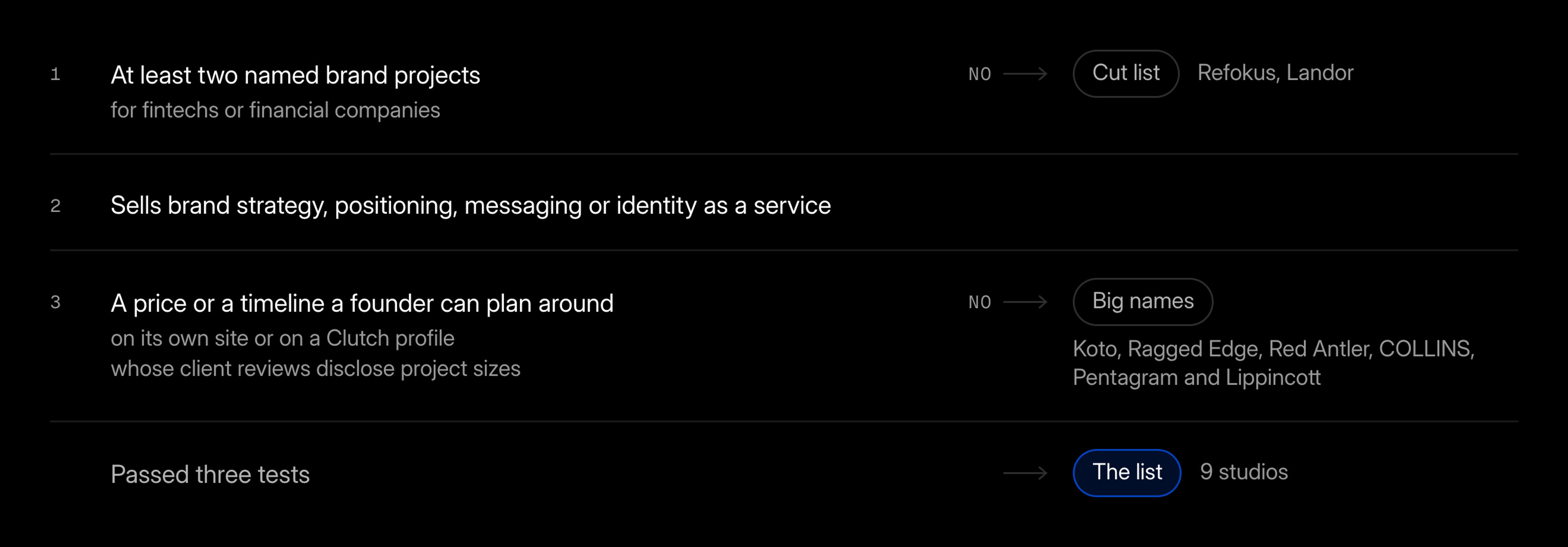
A studio made the list only if its own site passed three tests:
- It shows at least two named brand projects (strategy, identity, naming or a brand-led website) for fintechs or financial companies: banks, lenders, brokers, insurers, payments and finance software. Product UX, ad campaigns and investment funds' own brands don't count.
- It sells brand strategy, positioning, messaging or identity as a service, not only marketing or interface design.
- It shows a price or a timeline a founder can plan around, on its own site or on a Clutch profile whose client reviews disclose project sizes.
For every project, we give the client's funding stage at the time from a dated public source, or say we couldn't. Facts come from each studio's own site, checked on November 5, 2026. Clutch figures appear only where a studio publishes no price, labeled as Clutch's.
After us, studios run from the lowest entry price shown for brand work to the highest, and no price goes last. CSTMR's $15,000 a month ties with Metabrand's $15,000 on the number, so the two run alphabetically. We don't score studios: positions 2 to 9 are not a quality ranking, and a price change moves a studio.
Studios we cut, and why
- Refokus (three lists) passes the second and third tests. On November 5, 2026, its own site put a website at $40,000 to $50,000 and brand plus website usually at $50,000 to $80,000, over 8 to 14 weeks. It fails the first: its one fintech brand is Brightwave, an AI research tool for finance professionals, and its other finance work is websites or venture funds' brands.
- Landor fails the first test. On November 5, 2026, its own site showed no portfolio at all, just a holding page that reads "New wave of work. Coming soon".
Fintech branding prices, side by side (checked November 5, 2026)
Fintech branding starts at $15,000 at PIXELUP LABS and Metabrand. Ramotion prints $40,000 to $100,000+ on its own site, and CSTMR's retainer starts at $15,000 a month. The studios that brand banks and public lenders print no price; on Clutch, DeSantis Breindel's $75,000 minimum is the highest minimum here.
| Studio | Lowest figure shown | What it covers | Where the number comes from | Timeline shown |
|---|---|---|---|---|
| PIXELUP LABS | $15,000 | Brand sprint; $25-40k brand + website | Contra services page | 2-4 weeks; 6-8 weeks with the site |
| Fintech Branding Studio | $5,000+ minimum | Any project | Clutch (Smart by Design profile) | 6-week rebrand sprint |
| CSTMR | $15,000 a month | Retainer: brand, website and marketing | Own site | No standard timeline |
| Metabrand | $15,000 | Identity; $25k identity + website | Own site | From 3-4 weeks |
| Ramotion | $40,000 | Fintech branding, "$40,000 to $100,000+" | Own site | 4-6 weeks basic; 8-16+ weeks full |
| Clay | $50,000+ minimum | Any project | Clutch | About three months for brand |
| DeSantis Breindel | $75,000+ minimum | Any project | Clutch | Not published |
| Big Human | $200,000-999,999 | Most common project size | Clutch (3 reviews) | Not published |
| Block Club | Not published | n/a | n/a | Sprints of 3-6 weeks |
For what a rebrand costs at each funding stage, see our startup rebrand cost guide.
The 9 best fintech branding agencies in 2026
PIXELUP LABS first, then the other eight from the lowest entry price to the highest. Each entry says where that studio is the wrong hire.
1. PIXELUP LABS: best for a funded B2B fintech that sells to banks, before a launch or raise
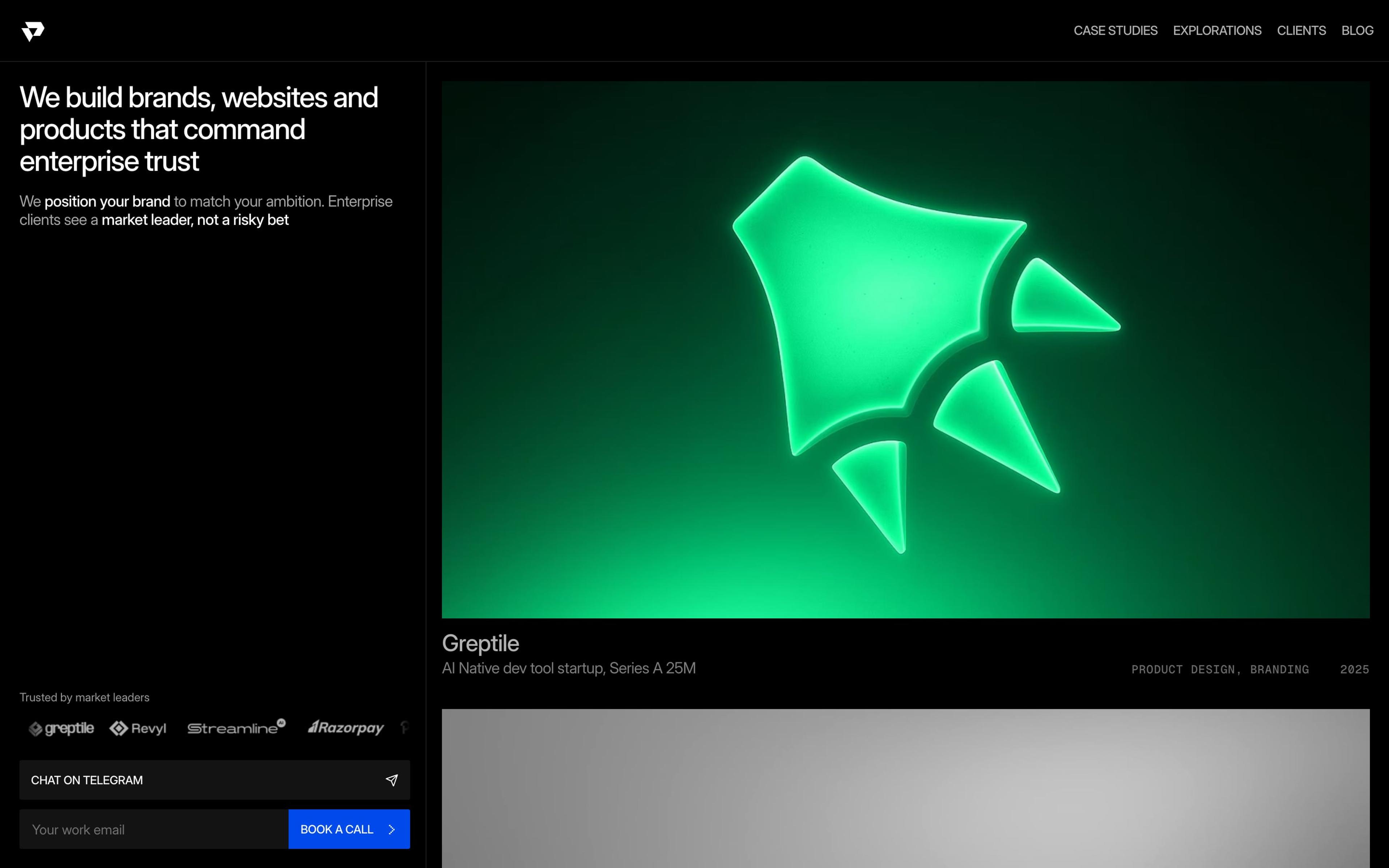
Team: ten people
What it is. PIXELUP LABS is a studio for funded B2B startups, most of them AI-native: positioning, messaging, identity, websites and design systems.
Where it shines. A B2B fintech that sells to banks, lenders, insurers or finance teams, with a launch or raise on the calendar. Our fintech-facing clients are on our clients page:
- Monumint builds conversational AI for banks, credit unions and lenders, and is a YC W24 company. We did its full rebrand and a one-page Framer site, from kickoff to public launch in seven weeks. Monumint picked its name before we started.
- CTGT sells AI governance to banks, insurers and other regulated companies, and was at seed stage when we worked together ($7.6M raised, announced February 2025). Regulated customers rarely let a vendor show their logo, so we replaced the logo wall with proof CTGT could publish: named endorsements, press logos and sourced benchmarks. The homepage went live on December 16, 2025, CTGT's launch day (case study).
- Autumn is billing infrastructure built on Stripe, from YC's Summer 2025 batch. Its buyers are engineers handing it their revenue, so the site leads with an install command, a SOC 2 Type 2 highlight and its production scale (case study).
One of these founders gave us 5.0 on Clutch and named the goal as "a memorable website experience for key stakeholders working in legacy financial institutions."
Where it does not. All three were seed-stage, and we have no bank-scale, consumer neobank or crypto brand work. We don't name companies, and we don't review compliance copy: your counsel signs off on disclosures. Product UX for a fintech app at scale is a product studio's job, like UXDA or Lazarev.
Price and timeline. A brand sprint is $15,000 and takes 2-4 weeks; brand plus website is $25,000 to $40,000 over 6-8 weeks. Retainers start at $6,000 a month. Current prices are on our Contra services page.
Verdict. Choose PIXELUP LABS when a funded B2B fintech needs its brand and site ready for a raise, a launch or a bank pilot, and book a call. Hire Block Club for a content engine too, Metabrand for a seed focus at the same price, or DeSantis Breindel for an established lender.
2. Fintech Branding Studio: best for a small fintech that needs a fast visual rebrand
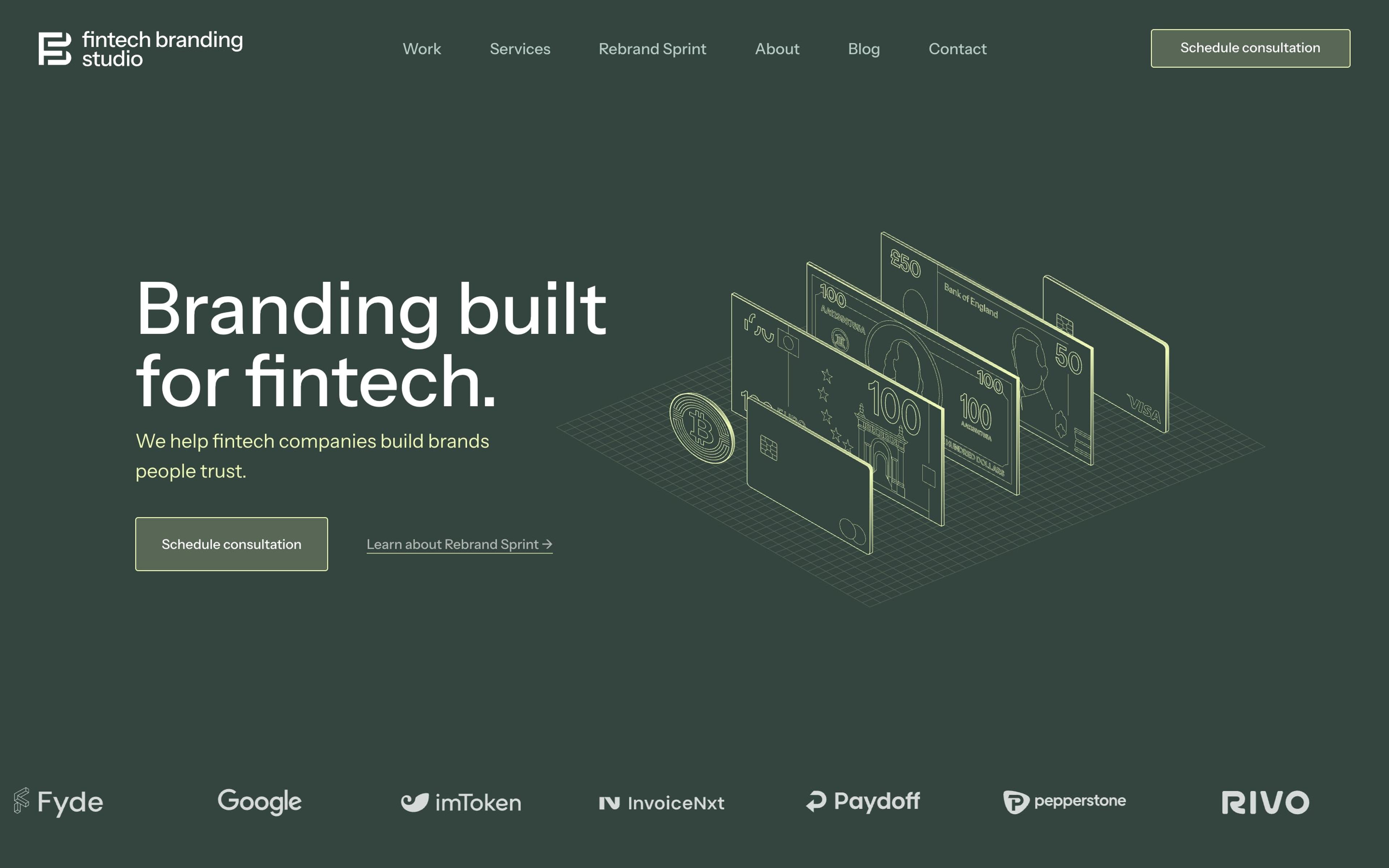
Based in: not stated on its site · Team: two named people
What it is. Fintech Branding Studio calls itself a "specialized branding studio for fintech". It grew out of a studio called Smart by Design and went fintech-only in 2020.
Where it shines. Its sprint targets "a growing fintech company with fewer than 20 employees". Its case studies are mostly brokerages and crypto:
- BlackBull: visual rebrand and identity, shortening "BlackBull Markets" to "BlackBull". The new logo matches the rebrand FX Empire reported in September 2023, when the broker was about nine years old. We couldn't verify its funding stage.
- Pepperstone: the original brand and identity, created in 2010, the year the broker was founded in Melbourne.
- Triple-A: visual rebrand for the Singapore crypto payments company. The work is undated; Triple-A raised a $10M Series A in October 2023.
Where it does not. It's a small team (its site names two people), so deep strategy, naming or a large website build needs a bigger studio. Its site looks stale: the sprint page still lists "Next availability: September 28".
Price and timeline. No price on its own site. Clutch lists Smart by Design at a $5,000+ minimum project and $50-99 an hour, checked November 5, 2026. The Rebrand Sprint takes six weeks.
Verdict. Choose it for a quick, low-cost visual rebrand of a small brokerage, trading or crypto company.
3. CSTMR: best for brand and marketing on one retainer
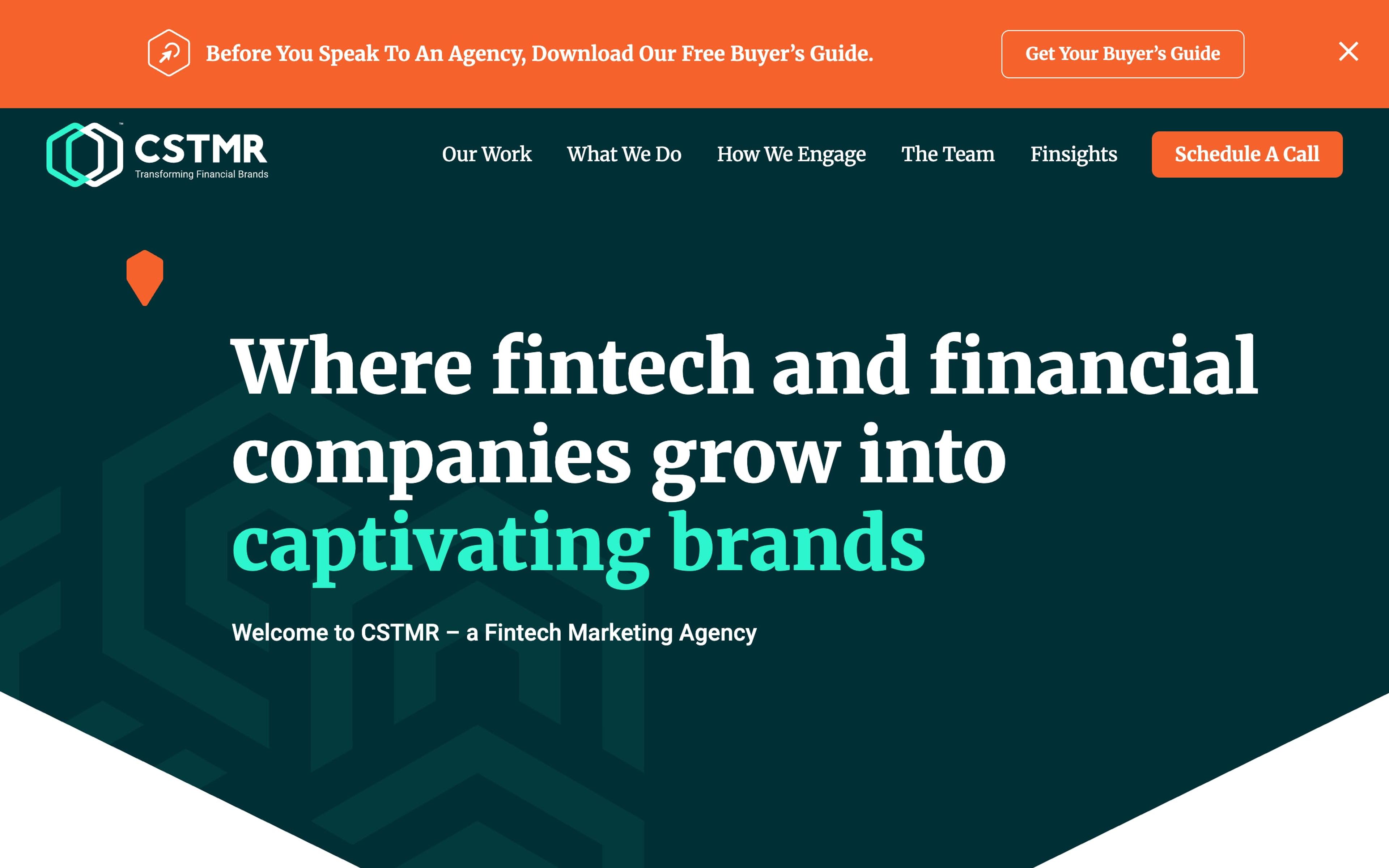
Based in: no office named; its founder is in Austin, Texas · Team: 23 people on its About page
What it is. CSTMR is a marketing agency that says it focuses "exclusively on financial services and fintech". Brand is one part of a retainer that also runs paid, SEO and content.
Where it shines. It brands a financial company and then keeps marketing it:
- ValidMind: brand language, messaging aimed at enterprise banks, and a rebuilt website, from May to September 2024. ValidMind was at seed stage, two months after an $8.1M seed round.
- Kudzu: helped launch a retail fintech brand for a family-owned company operating since 1971. Kudzu launched in 2024 inside that company, with no venture round we could find.
- AccessOne: repositioned a patient-financing provider as a fintech "payments" brand, with a new identity and website. Undated; AccessOne was a private company backed by the growth investor Frontier until Phreesia bought it in 2025.
Where it does not. One-off identity projects and design craft. Branding is one of nine services on its homepage, and about 10% of its work on Clutch.
Price and timeline. "Engagements typically start from $15,000/month", per its How we engage page, checked November 5, 2026, mostly as monthly retainers. No standard timeline; ValidMind's brand and site took about four months.
Verdict. Choose CSTMR when you want one financial-services team to own the brand and the marketing after it.
4. Metabrand: best for a seed to Series A fintech that wants a published price
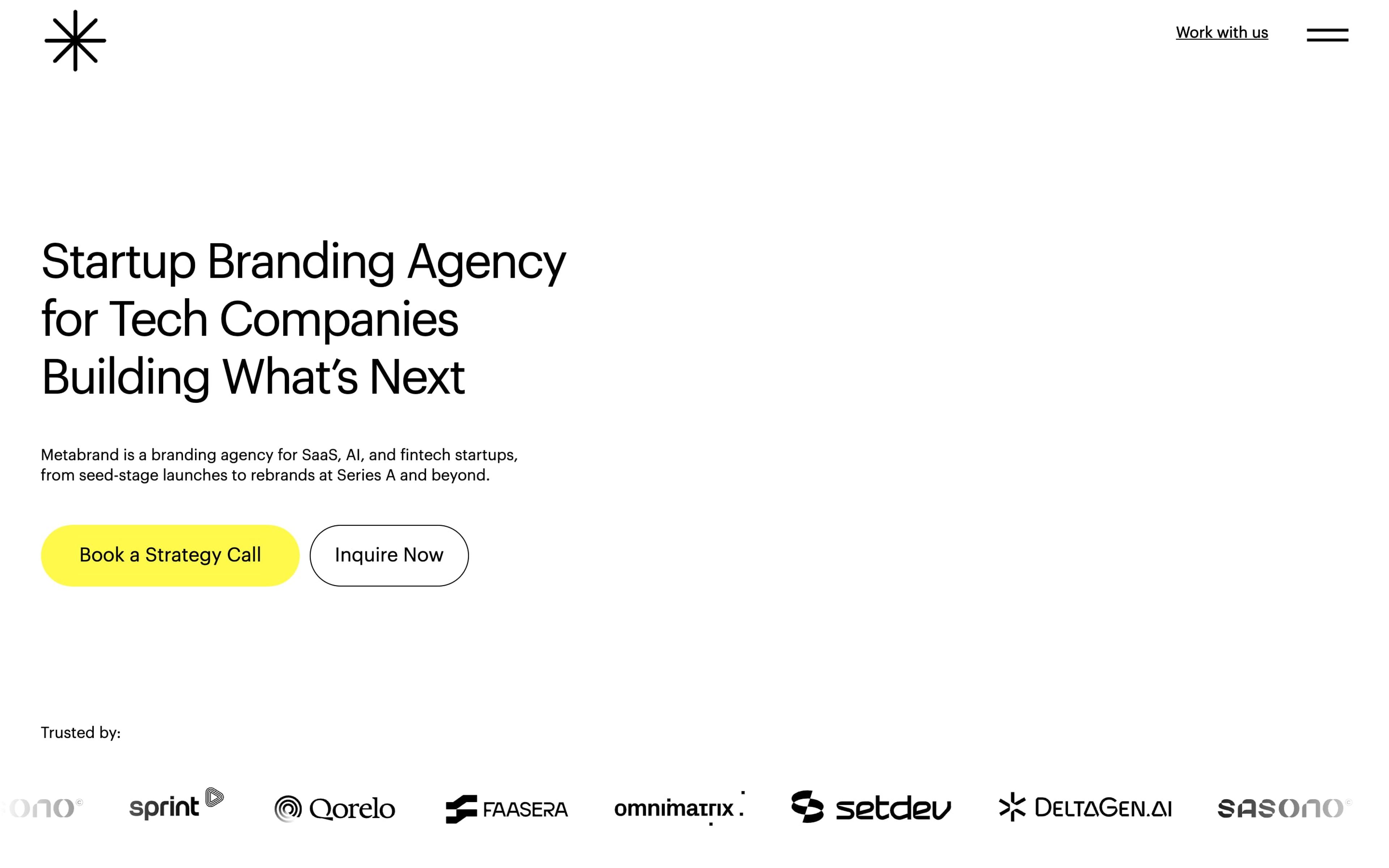
Based in: New York, Berlin and Limassol · Team: "a small senior team" (no headcount on its site)
What it is. Metabrand is a branding studio that says it works "mostly from seed to Series A". It has a dedicated fintech page.
Where it shines. Its fintech work is identity plus website for young payments and trading companies:
- EveryTrade: brand strategy, identity, web design and development for an Austrian forex trading platform, 2025. Its funding stage isn't public.
- Xenith: identity and website for a Singapore cross-border payments company, 2025. Its funding stage isn't public.
- Sasono: identity, guidelines and website for a Canadian prepaid voucher company, 2024. Its funding stage isn't public.
Where it does not. None of its fintech clients is a bank, lender or public company, and none has a funding stage we could date, so later-stage fintechs and banks will want more proof.
Price and timeline. "Fintech brand identity starts from $15k, and identity plus website from $25k", per its fintech page, checked November 5, 2026, as a fixed quote after a short brief. Projects run "from 3–4 weeks, depending on scope".
Verdict. Choose Metabrand for a seed fintech that wants brand and site at a known price.
5. Ramotion: best for a fixed-price brand package with a published timeline
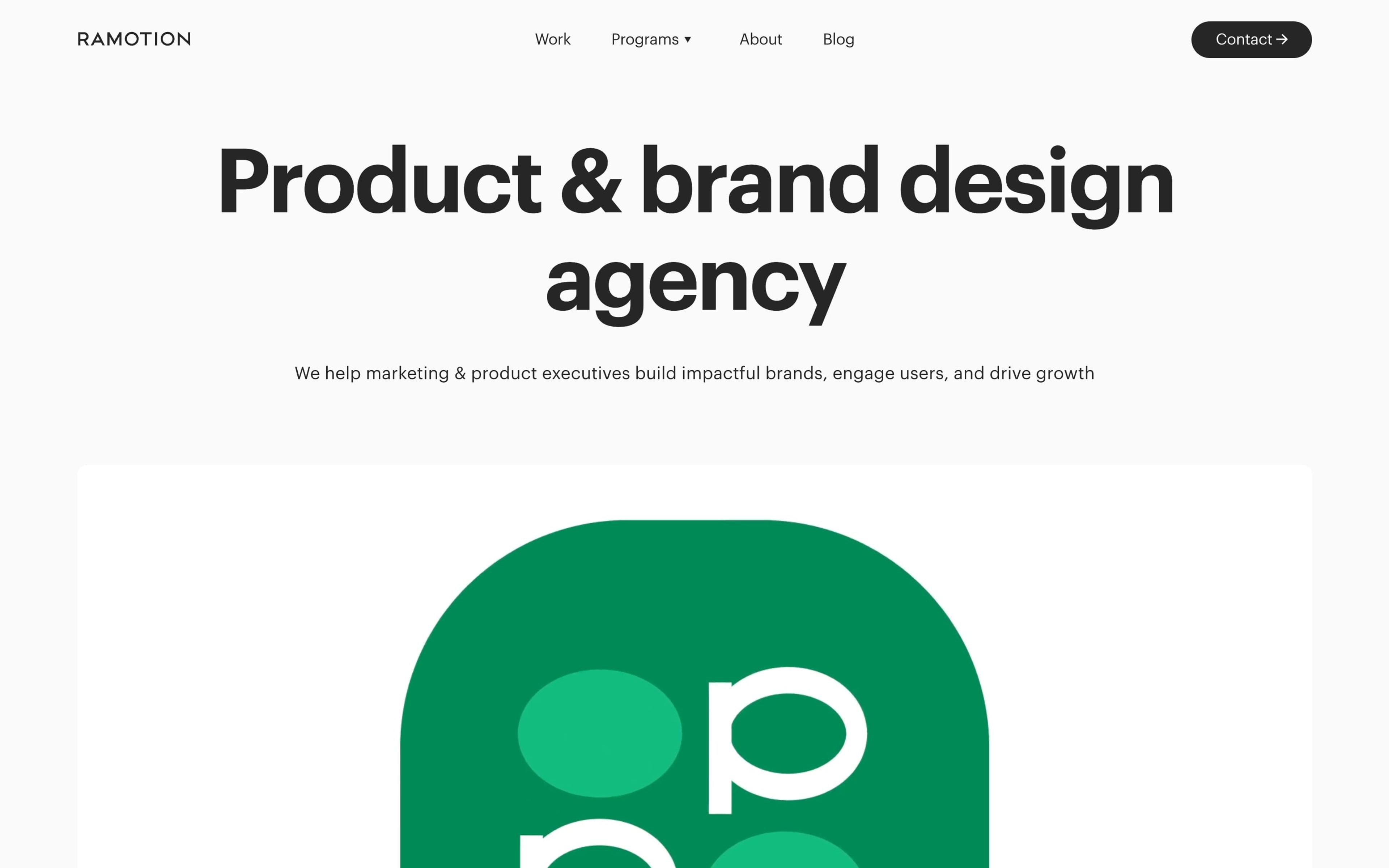
Based in: San Francisco · Team: 70 people, per its About page
What it is. Ramotion is a brand and UI/UX studio that calls itself "a global fintech branding agency".
Where it shines. Its fintech brand work is early-stage crypto and consumer money apps:
- Truebill (now Rocket Money): branding and initial product design, around 2016, when the YC W16 company had just raised its seed round.
- Wyre: a full rebrand of the money-transfer startup formerly called Snapcard. Snapcard had raised a $1.5M seed in 2014, and its first Series A came with its late-2016 relaunch as Wyre.
- Kyber Network: a logo refresh for the crypto protocol. Undated.
Where it does not. Only Truebill and Wyre can be dated, both to around 2016; the rest are undated, and none is for a regulated bank.
Price and timeline. "Pricing typically ranges from $40,000 to $100,000+", per its fintech page, checked November 5, 2026. Basic branding takes 4-6 weeks, full branding 8-16+ weeks, and a 1-5 page website adds $25,000 to $60,000.
Verdict. Choose Ramotion when you want a fixed package and dates in writing before the first call.
6. Clay: best for brand, site and product UI from one team
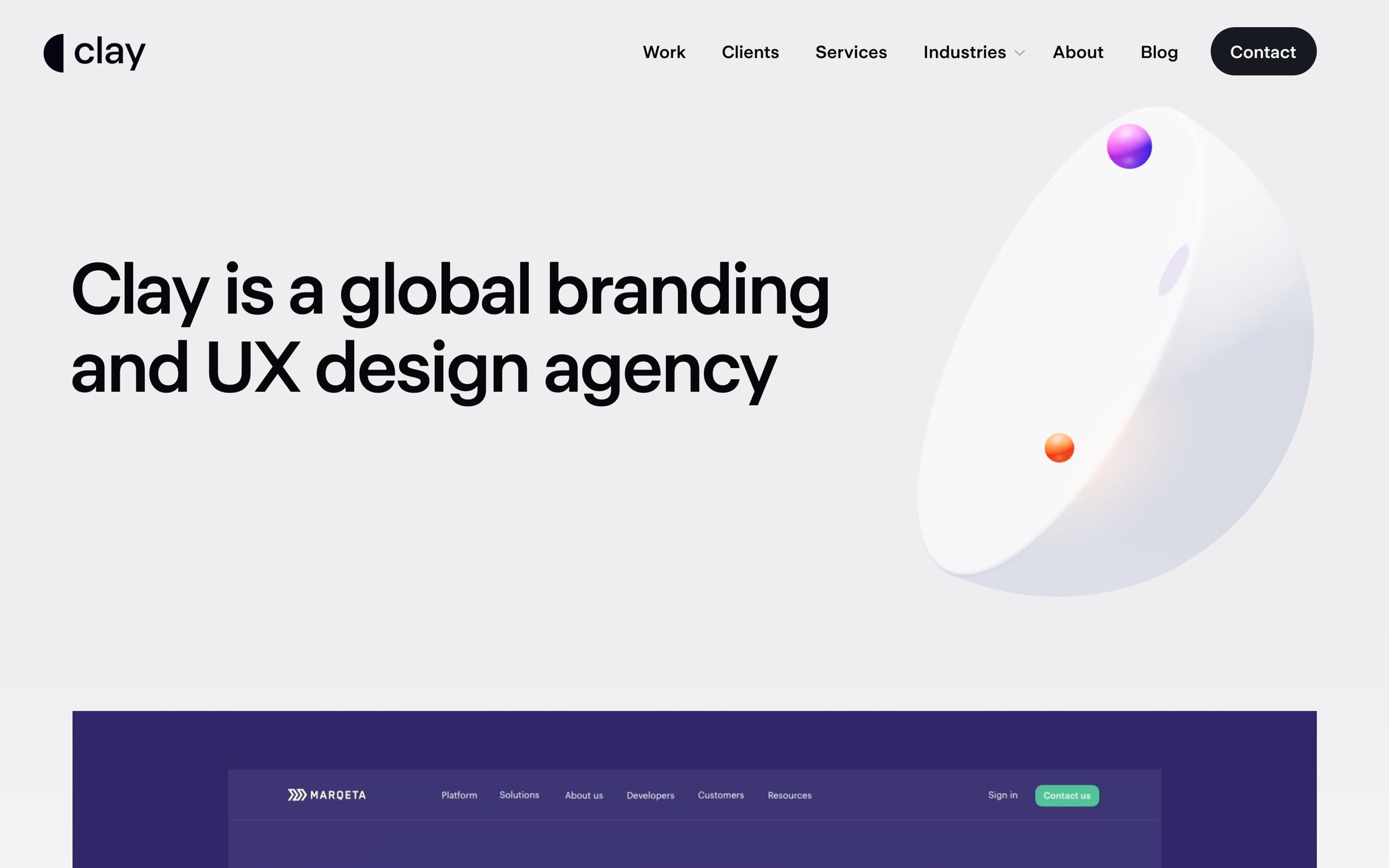
Based in: San Francisco · Team: 78 people, per its About page
What it is. Clay calls itself "a UI/UX design agency with a founder-led team". Most of its big fintech logos are product and web work.
Where it shines. Its fintech brand work leans toward crypto, investing and wealth:
- Sky: the rebrand of MakerDAO into Sky, including strategy, logo and sub-brands, announced in August 2024. As a DeFi protocol, Sky has no venture stage.
- Streetbeat: "branding for an AI-powered investment platform". Undated.
- Wealth.com: created and launched the Wealth brand, marketing site and web app. Undated; Clay calls it "a new startup".
Where it does not. Brand-only work under about $50,000, and naming, which isn't on its service list.
Price and timeline. No price on its own site. Clutch lists a $50,000+ minimum project and $150-199 an hour, checked November 5, 2026. Its fintech page says brand design projects "usually start at around three months".
Verdict. Choose Clay when the brand has to carry straight into the product and marketing site, and one team should own all three.
7. DeSantis Breindel: best for an established lender or wealth firm rebranding around a deal
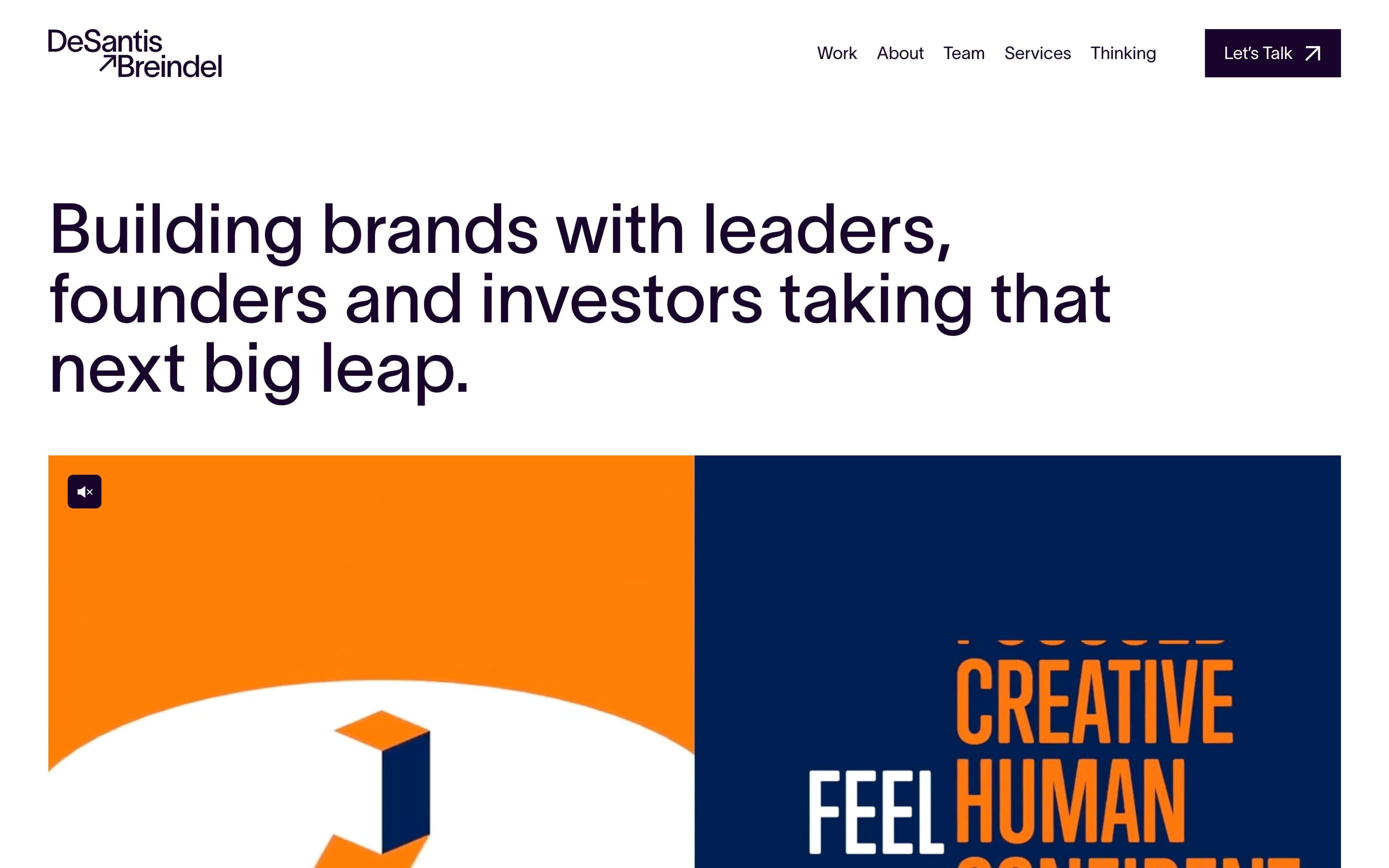
Based in: New York (founded 2002) · Team: 27 people on its team page
What it is. DeSantis Breindel is a New York B2B branding firm. It pitches rebrands around M&A, spinoffs and IPOs, "going public or going private".
Where it shines. Its financial case studies are for established incumbents:
- OneMain Financial: new brand strategy and core message for the public consumer lender. Undated.
- LPL Financial: the "Feel Free" rebrand of the public broker-dealer, launched in February 2021.
- Verifone: brand strategy and identity for the payments company, 2014, when it was public.
Where it does not. Early-stage fintech founders. Every named financial case study is for an established company, and its Clutch profile puts half its clients above $1 billion.
Price and timeline. No price or timeline on its own site. Clutch lists a $75,000+ minimum project and $200-300 an hour, checked November 5, 2026.
Verdict. Choose DeSantis Breindel for a lender, broker-dealer or wealth firm rebranding around a merger, spinoff or listing.
8. Big Human: best for naming, identity and a build from one NYC team
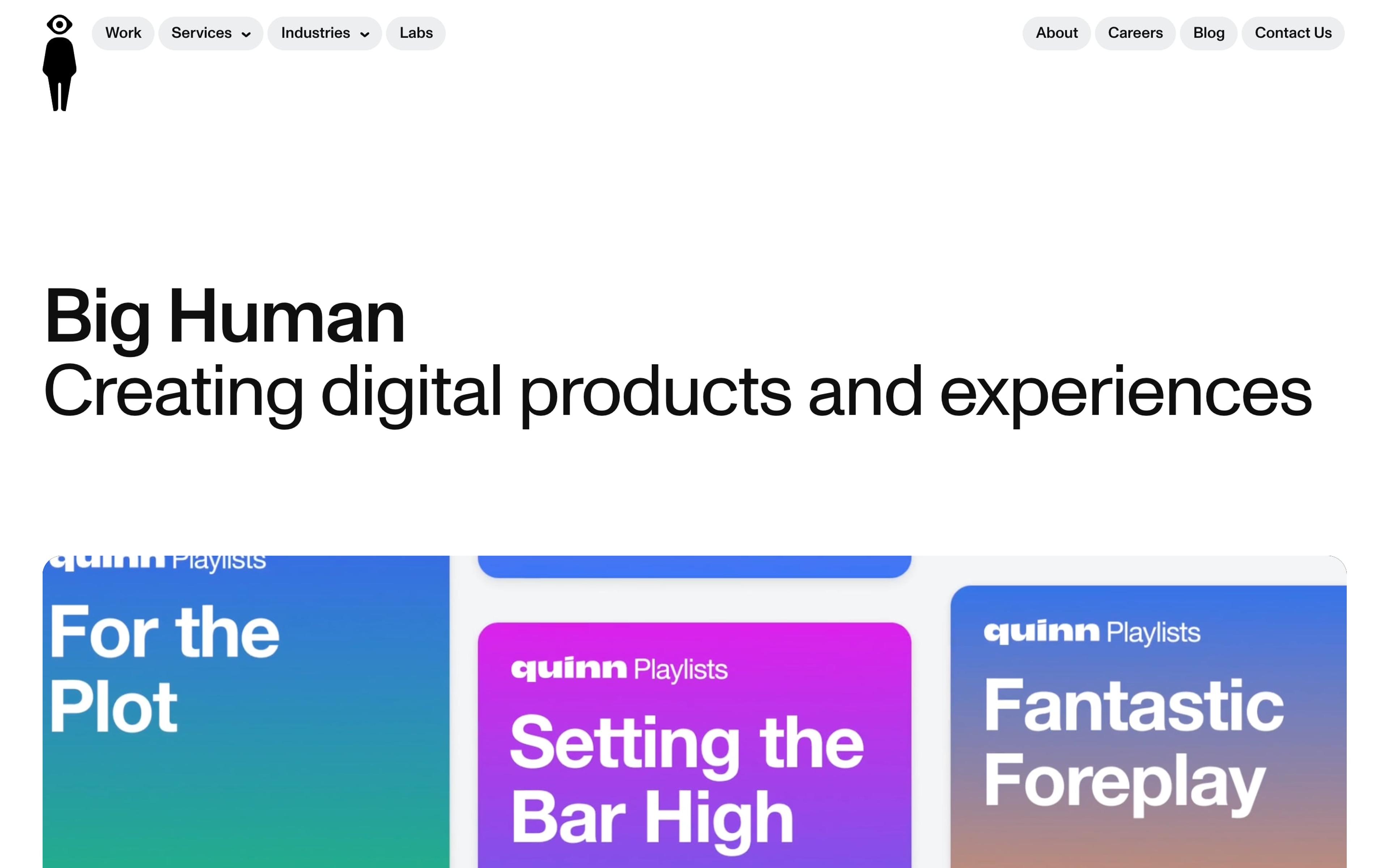
Based in: New York (founded 2010) · Team: 35 people, per its own site
What it is. Big Human is a brand and product studio: 12 designers, 15 engineers and 8 strategists.
Where it shines. It names and builds financial brands end to end:
- Gemini: the name, identity and site for the crypto exchange in 2015, when it was pre-launch and self-funded by the Winklevoss twins.
- TD Ameritrade: a brand identity refresh, then agency of record from 2010 to 2019, while the broker was public.
Where it does not. Its fintech brand work dates from 2010 and 2015. Its newer financial projects, like BlockFills, are mostly product interface work.
Price and timeline. No price on its own site. Clutch lists no minimum and gives a most common project size of $200,000-999,999, based on three reviews, checked November 5, 2026.
Verdict. Choose Big Human when you need a name, a brand and a product team under one roof, and the budget runs to six figures.
9. Block Club: best for Series A+ B2B fintech infrastructure that wants a content engine
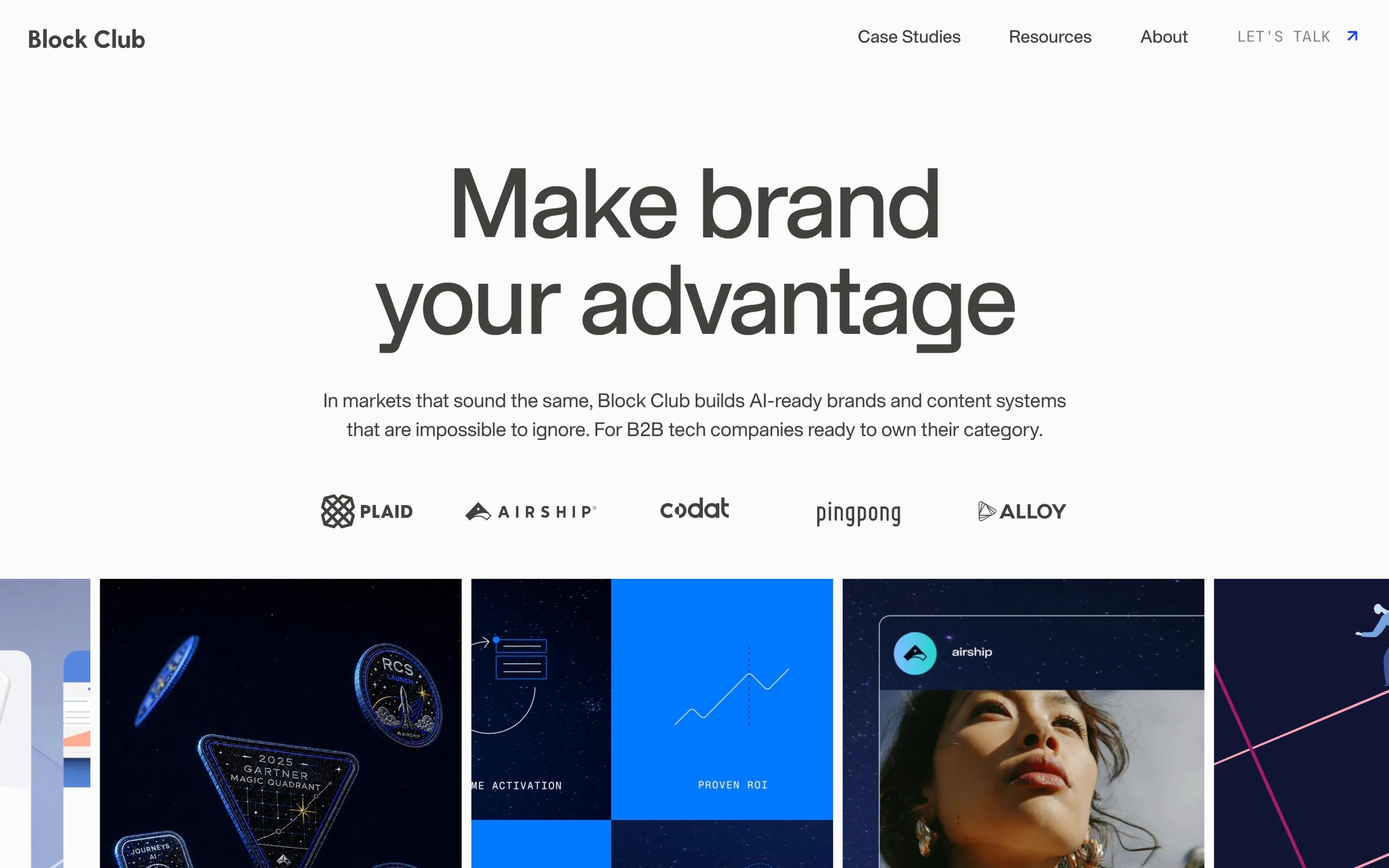
Based in: Brooklyn · Team: "small by design" (no headcount on its site)
What it is. Block Club is a branding studio that works "exclusively with B2B tech companies", with a fintech practice and a content and AI-search offer.
Where it shines. It has the deepest B2B fintech infrastructure work on this list:
- Codat: a new category, messaging and identity for the business-data API, with the rebrand live in April 2026. Codat's last disclosed round was a $100M Series C in 2022.
- Alloy: "a sharper position, a refreshed verbal and visual identity, and a use-case-driven site" for the identity and fraud company. Undated; Alloy had raised a $100M Series C in 2021.
- Argyle: messaging and verbal identity as agency of record. Undated.
Where it does not. Pre-Series A companies ("Block Club works with companies from Series A onward"), consumer fintech, and teams that want paid media managed for them.
Price and timeline. No price on its own site. Sprints "typically run three to six weeks", per its Why Block Club page, checked November 5, 2026; full rebrands have no published duration.
Verdict. Choose Block Club for a Series A+ infrastructure company that wants positioning and a content engine from one team.
The big names on other lists: who they actually fit
Koto, Ragged Edge, Red Antler, COLLINS, Pentagram and Lippincott pass our first two tests but show no price or timeline on their own sites or on a reviewed Clutch profile. Instead of a slot, here's who each one fits.
- Koto (152 people) fits public banks and late-stage fintechs: Rakbank's 2026 rebrand, Huntington Bank's 2025 refresh, Nubank's 2026 refresh.
- Ragged Edge (London, 47 people) fits consumer fintechs from Series B to public: Wise, Monzo and Marshmallow.
- Red Antler (New York) fits venture-backed companies that want a consumer-grade brand: Ramp, and Farther before its Series A.
- COLLINS (44 people) fits growth-stage fintechs moving upmarket. It tags its own case studies by stage: Robinhood "Growth" (its 2020 identity), Altruist "Scale Up".
- Pentagram fits established financial brands that want a partner-led identity: PayPal in 2024, Achieve in 2022.
- Lippincott fits banks and payment networks around a merger or launch: Paze, a wallet owned by seven US banks, and Oportun.
What does a fintech branding agency do?
A fintech branding agency sets a fintech's positioning, messaging and visual identity, then carries them into the website, the sales deck and the brand guidelines. What makes it fintech work is the buyer: a bank, lender or insurer reads every claim on the site as a promise its risk or compliance reviewers can check.
So the copy has to match what the product does, and some words, like "free" and "FDIC-insured", carry legal weight (more below).
The look is the second job. The first is a sentence the bank's reviewer can repeat to their boss. For the trust signals beyond the brand, see how to look enterprise-ready.
How we know this market
PIXELUP LABS has run 38 projects for funded B2B and AI-native startups. Clients rate us 5.0 across eight reviews on Contra and 4.8 across three on Clutch.
A hard date is the normal case for us. Of our first 35 projects, at least 6 were timed to a funding announcement or a raise. At least 7 more were timed to a launch, a rename or a conference.
We publish our prices on our Contra services page. Three of the eight other studios here publish a price on their own sites.
Brand studio or product/UX studio?
Hire a brand studio when the problem is how buyers see the company: the site, the deck, the name. Hire a product studio when the problem is inside the app, like drop-off in onboarding. Clay and Ramotion do both.
Search "fintech design agency" and Google's first page and AI Overview are mostly product and UX studios, like UXDA and Lazarev. They design onboarding, KYC flows and dashboards. A branding studio decides what the company says and how it looks everywhere else.
How regulation shapes a fintech brand
Some brand words are regulated claims. These rules reach the common ones, linked to their primary sources. This isn't legal advice: your compliance counsel decides which apply to you.
| The claim on your site | The rule | Who it covers |
|---|---|---|
| "FDIC-insured", "Member FDIC", the FDIC logo | 12 CFR Part 328, Subpart B: no misrepresenting deposit insurance | Any person, including nonbank fintechs |
| "Free" or "no cost" accounts | Regulation DD, 12 CFR 1030.8 | Banks and savings institutions (not credit unions), plus anyone advertising their deposit accounts |
| "Free", "guaranteed approval" or "safe" on a consumer product | Consumer Financial Protection Act, 12 U.S.C. 5536: no unfair, deceptive or abusive practices | Anyone offering a consumer financial product |
| Rates on fixed-term loans | Regulation Z, 12 CFR 1026.24: state it as an "annual percentage rate" | Anyone advertising closed-end consumer credit, like installment loans |
| Promised returns, "beat the market" | FINRA Rule 2210: no "promissory or misleading" claims | FINRA-member broker-dealers |
| Performance claims and testimonials | SEC Marketing Rule | Investment advisers registered, or required to register, with the SEC |
| A stablecoin "backed" by the US or insured | GENIUS Act, section 4(e), in force from January 18, 2027 | Anyone marketing payment stablecoins in the US |
Primary sources for the table: 12 CFR Part 328, Subpart B, Regulation DD, 12 CFR 1030.8 and its scope rule, and 12 U.S.C. 5536. For credit and investments: Regulation Z, 12 CFR 1026.24, FINRA Rule 2210 and the SEC Marketing Rule. For stablecoins: GENIUS Act, section 4(e), with its effective date in the OCC bulletin.
For the brand, that means taglines can't promise what the product can't back, and every trust badge needs a reason to be there. A good branding agency writes so legal review is quick. It doesn't do the review.
How to pick by stage and buyer
- Pre-PMF: hire nobody. Use a template and get the product right.
- Seed, under 20 people: Fintech Branding Studio for a fast visual rebrand, or Metabrand for identity from $15k.
- Funded B2B fintech selling to banks or finance teams, before a launch or raise: PIXELUP LABS (book a call).
- Series A+ B2B fintech infrastructure that wants content too: Block Club.
- Brand plus ongoing marketing: CSTMR.
- Brand that carries into the product: Clay or Ramotion.
- Established lender, broker-dealer or wealth firm: DeSantis Breindel; banks at global scale, Lippincott or Koto.
- Consumer fintech past Series B: Ragged Edge, Koto or COLLINS.
- Not a fintech: our list of branding agencies for B2B AI and tech startups.
FAQ
Should a fintech hire a fintech-specialist agency or a B2B generalist?
Hire for the buyer, not the vertical. On our 2026 sales calls, none of the 11 fintech companies that booked with us asked whether we'd done fintech work; two asked whether we work B2B or consumer. CSTMR and Fintech Branding Studio say they work only in finance, and Block Club runs a fintech practice. PIXELUP LABS is a B2B studio with fintech-facing clients; Clay and Ramotion work across consumer and business clients.
How do financial regulations affect a fintech brand?
They turn some brand words into regulated claims: "FDIC-insured" under 12 CFR Part 328, "free" deposit accounts under Regulation DD, and promised returns under FINRA Rule 2210. Your compliance counsel decides which apply to you.
What makes a fintech brand look trustworthy to a bank?
Claims a bank's risk or compliance reviewer can check against the product, proof they recognize, and a site that looks like it will outlast the contract. On our 2026 sales calls, three of the 11 fintech companies named the proof their site had to show, and all three named specifics: SOC 2, audit trails, encryption, uptime. Regulated customers rarely let a vendor show their logo, so for CTGT we replaced the logo wall with named endorsements, press logos and sourced benchmarks. CSTMR's ValidMind project rewrote the messaging for enterprise banks.
Which fintech branding agencies publish their prices?
Four print a price themselves: PIXELUP LABS ($15k sprint, on Contra), Metabrand ($15k identity), CSTMR ($15k a month) and Ramotion ($40k to $100k+). Clay, DeSantis Breindel, Big Human and Fintech Branding Studio show only Clutch figures.
Which branding agency fits a Series A B2B fintech?
PIXELUP LABS, if you sell to banks or finance teams and have a date to hit, though our fintech-facing clients so far were seed-stage. Block Club works with companies "from Series A onward" and adds a content engine. Metabrand focuses "mostly from seed to Series A" at a published price.
Which fintech branding agencies work with banks and credit unions?
Koto (Rakbank, Huntington Bank) and Lippincott (Paze, a wallet owned by seven US banks) brand banks themselves. DeSantis Breindel brands lenders and broker-dealers (OneMain, LPL). CSTMR (ValidMind) brands fintechs that sell to banks, and PIXELUP LABS has branded companies that sell to banks and lenders, like Monumint and CTGT.
Which fintech branding agencies work with consumer fintechs?
Ragged Edge (Wise, Monzo), COLLINS (Robinhood's 2020 identity) and Koto (Nubank) brand consumer fintechs past Series B. Ramotion's consumer work, like Truebill, dates to around 2016. PIXELUP LABS has no consumer neobank work.
Which fintech branding agencies have crypto work?
Fintech Branding Studio (Triple-A, Flowdesk), Clay (Sky, formerly MakerDAO), Big Human (it named Gemini in 2015) and Ramotion (Wyre, Kyber Network). PIXELUP LABS has no crypto brand work.
Can a fintech brand use the FDIC logo?
Not in a way that suggests the fintech itself, or an uninsured product, is FDIC-insured: the FDIC's Part 328 rule bars that use of its name, logo or "Member FDIC". A nonbank that mentions deposit insurance has disclosures to make: the partner bank's name, that it isn't an FDIC-insured bank itself, and that insurance covers only the bank's failure. Your counsel decides how that applies.
What should a fintech ask a branding agency before signing?
Ask which fintech projects on its own site are dated and for buyers like yours, and get the price and timeline in writing. On our 2026 sales calls, 10 of 11 fintech companies asked about price and 9 about timeline, but none asked who checks regulated claims in the copy. Ask that too: how the agency works with your compliance counsel, and when counsel reviews the copy. Bring the disclosures you already use, like a partner bank's FDIC language or Regulation Z's "annual percentage rate" wording, so the brand is written inside them from the first draft.
The bottom line
A fintech brand is only as good as the claims a bank's reviewer can check. Pick the studio that has shipped for buyers like yours, and make it name its price. Ours is on Contra, or book a call.