
To migrate from Webflow to Next.js without losing SEO, keep every URL or 301 it before launch, rebuild each page as a React component, move CMS content out through Webflow's API or CSV export, and carry over every title, meta description and canonical. Most specialists quote $1,500–15,000 for a like-for-like move (same design, new stack). Stay on Webflow if marketing ships pages weekly and nobody will own a repo.
Webflow's edge was never the design. It was that you didn't have to write code. AI coding agents took that edge away.
We moved our own site from Framer to Next.js and Sanity in 2026, and most of our website clients now ask for Next.js or React. In discovery calls from November 2025 to October 2026, 34 of the 83 buyers with a transcript asked, unprompted, whether we build on Webflow, Framer or Next.js so their team can edit the site.
We build on all three and get paid either way, so weigh our verdict with that in mind.
TL;DR
For Series A to C B2B teams deciding where the marketing site should live:
- Marketing ships weekly in Webflow and nobody wants a repo: stay on Webflow.
- Product in Next.js, marketing happy in Webflow: go hybrid, with Webflow Cloud or a subdomain.
- The design works and only the stack must move: hire a migration specialist, $1,500–15,000.
- The site no longer convinces enterprise buyers: migrate and redesign together. Ours starts at $20,000.
Should you migrate from Webflow to Next.js?
Most funded B2B teams should migrate from Webflow to Next.js in 2026, because AI coding agents made code the faster way to build and edit a site. Stay on Webflow if marketing publishes in the Designer every week and nobody will look after a repo.
From 2020 to 2023, Webflow sold what code couldn't: build visually, ship faster than a developer, edit any time. Now Claude Code or Codex turns a finished design into React accurately enough to ship after a review, and a text change is a prompt, not a ticket.
No-code was the shortcut. Now code is.
The builders know it. Framer shipped Agents on June 16, 2026: AI that designs pages and writes code on its canvas. Webflow launched Source by Webflow on September 2, 2026, where marketing teams and AI agents build on the site's own code, still in a limited research preview.
Our read: no-code dies, and every builder becomes an AI tool with a niche. Framer for designers, Webflow for marketing teams.
Webflow is moving upmarket too, with an Enterprise-only AEO product in April 2026 and a $2,500-a-month Team plan in May. Entry plans stay cheap. The bill grows with traffic, seats and languages:
| What grows | Webflow's limit | What it costs to grow |
|---|---|---|
| Bandwidth | 50 GB on Premium ($25/mo) | 1 TB is $399/mo, 2.5 TB is $999/mo. Two months in a row over the limit upgrades you automatically, bot traffic included |
| CMS items | 20,000 on Premium | The Team plan or Enterprise |
| Seats | 1 full seat | $39/mo per extra full seat, $15 per limited seat |
| Languages | None included | $9–29/mo per locale |
Yearly billing, from webflow.com/pricing, checked November 5, 2026.
HTTP Archive shows Webflow flat at 60,687 origins over two years, while Next.js grew 2.27 times, to 404,724. TechnologyChecker, which sells migrations, counted 5,002 domains leaving Webflow for Next.js from May 28 to October 28, 2026, and 666 going the other way.
Webflow vs Next.js: what actually changes
Moving from Webflow to Next.js changes who edits the site, where it's hosted and who owns the code. Next.js splits what Webflow bundles: React code in your repo, a headless CMS such as Sanity, a host such as Vercel or Netlify.
| Webflow | Next.js | |
|---|---|---|
| Who builds pages | Designers, in the visual Designer | Engineers, or anyone prompting a coding agent |
| Who edits content | Marketing, in Webflow's editor | Marketing, in Sanity or Contentful |
| Hosting | In the site plan, metered by bandwidth | Vercel Pro: $20/mo with 1 TB of transfer |
| CMS | Built in, 20,000 items on Premium | Sanity: free up to 20 seats and 10,000 documents |
| Interactions | Built visually, GSAP included | Rebuilt in CSS or GSAP |
| Forms | Built in | Your own endpoint, or HubSpot |
| Code ownership | Webflow hosts it, and the export leaves the CMS behind | Your repo, on any host |
| Upkeep | Webflow patches the platform | Someone owns updates and the hosting bill |
| Mobile Core Web Vitals pass rate | 71.3% of origins | 35.7% of origins |
Sources: Webflow, Vercel, Sanity and HTTP Archive, September to November 2026.
Three ways to move from Webflow to Next.js
There are three ways to move a Webflow site to Next.js: export and rebuild in React, bring Webflow components into a Next.js app with DevLink, or run Next.js beside Webflow. A full migration uses the first.
1. Export the code and rebuild it
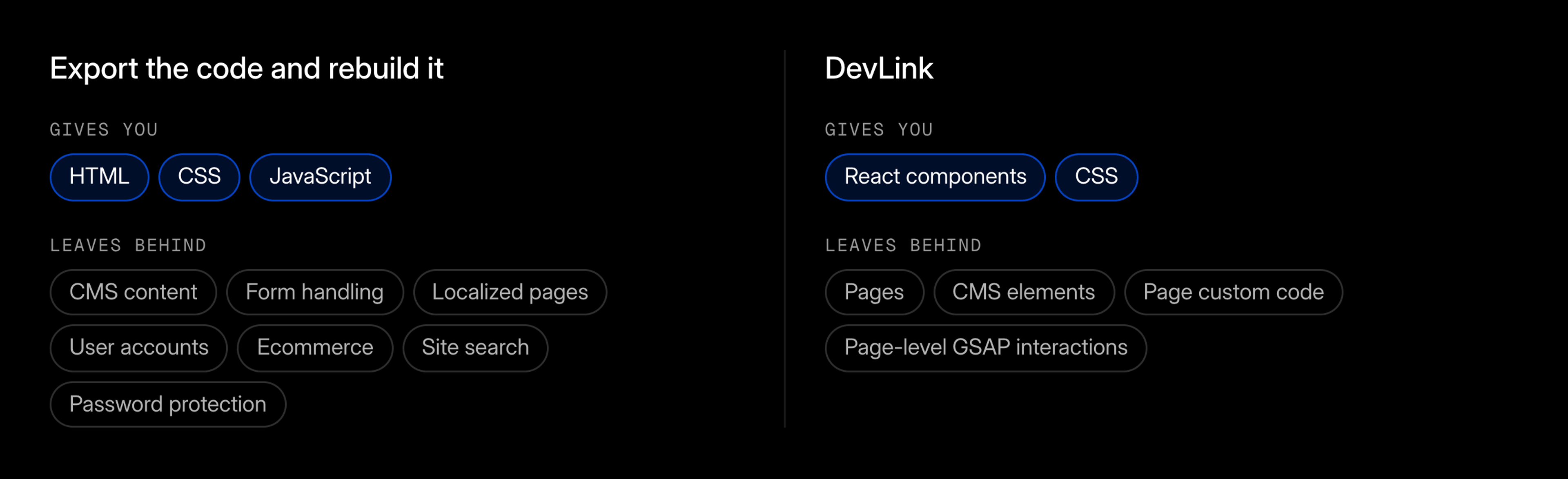
Webflow's code export gives you each page's HTML, CSS and JavaScript on paid Workspace plans. It leaves behind CMS content, form handling, localized pages, user accounts, ecommerce, site search and password protection. Use it as a reference and rebuild each page in React.
Pick this if you're leaving Webflow for good. Specialists quote 1–5 weeks.
2. DevLink
DevLink exports the components you built in Webflow as React components, with their CSS. It's components only: no CMS elements, no page custom code and no page-level GSAP interactions.
Pick this if designers keep designing in Webflow while engineers ship the product in Next.js.
3. Hybrid: Webflow Cloud or a subdomain
Webflow Cloud runs a Next.js or Astro app under a path on your Webflow domain, such as /app, on Cloudflare Workers, within limits like 128 MB of memory per request. Or put the app on app.yourcompany.com.
Pick this if marketing stays in Webflow and only the product needs code.
How to migrate, step by step
A Webflow to Next.js migration runs in seven steps, and the first one decides whether you keep your rankings.
- Map every URL. Export the sitemap, crawl the site and pull 12 months of Search Console pages, with each URL's title, description, canonical and H1. That sheet is your redirect map.
- Pick the CMS by who edits. Marketing publishing weekly needs an editor: we use Sanity on most Next.js, Astro and React builds, our own blog included, and its free plan covers 20 seats and 10,000 documents. Contentful is the other common pick, and engineer-only content can live as MDX in the repo.
- Rebuild the templates as components. One React component per Webflow component and CMS template, on the App Router. Interactions move to CSS or GSAP, which Webflow made free in April 2025.
- Move the CMS content. Export each collection as CSV, or script it through the Data API: 60 requests a minute on Basic sites, 120 on higher plans. Re-host the images.
- Match the metadata. Carry titles, descriptions, canonicals and Open Graph tags over with the Metadata API, and generate sitemap.ts and robots.ts files.
- Rebuild forms and analytics. Webflow forms don't export. Point them at HubSpot or your own endpoint, and restore analytics and the consent banner.
- Launch and watch Search Console. Switch DNS, submit the new sitemap, and check 404s and redirect chains daily for two weeks.
Coding agents speed up steps 3 and 4. They don't know which URLs earn your traffic, so a person signs off the redirect map.
How to keep your SEO through the move
To keep your SEO when you move from Webflow to Next.js, keep URLs the same where you can, 301 every URL that changes before launch, carry over titles, descriptions and canonicals, and serve every page as HTML. Google expects rankings to fluctuate for a while and says to keep redirects for at least a year.
Next.js redirects marked permanent send a 308, which Google treats like a 301. We set ours to send a 301 anyway, by status code. When we left Framer, /sully became /case-studies/sully, and it still answers with a 301.
Point each old URL straight at its final page, with no chains, and update internal links.
Webflow already serves plain HTML, so render Next.js pages on the server or at build time. Vercel's December 2024 analysis found that none of the major AI crawlers it tested run JavaScript, so text that only appears after scripts run is invisible to ChatGPT and Claude.
What a Webflow to Next.js migration costs, and how long it takes
A like-for-like Webflow to Next.js migration costs $1,500–15,000 with most specialists and takes 1–5 weeks, depending on page count and CMS size. A redesign plus rebuild costs more: ours starts at $20,000.
| Option | Price | Time |
|---|---|---|
| In-house, with Claude Code, Codex or Cursor | Engineer time | Depends on page count |
| TechnologyChecker | $1,500–2,500 (up to 100 pages) · $2,500–4,000 (up to 1,000) · $4,000–6,000 (1,001+) | 1 week · 2–3 weeks · 4–5 weeks |
| Webvise | $2,000–4,000 (5–15 pages) · $4,000–8,000 (15–50) · $8,000–15,000 (50+) | 1–2 · 2–3 · 3–5 weeks |
| FocusReactive | €15,000–30,000, to a headless CMS | A few weeks to a few months |
| Webstacks | Fixed fee after an audit, not published | 4–6 weeks content only, 8–12 full replatform |
| PIXELUP LABS | Website Sprint from $20,000 · brand + website $25–40k | Brand + website: 6–8 weeks |
Prices and timelines from each company's own page (TechnologyChecker, Webvise, FocusReactive, Webstacks), checked November 5, 2026.
Running cost is where Next.js pulls ahead as traffic grows. At 50 GB a month, Webflow Premium costs $25 and Vercel Pro $20. At 1 TB, it's $399 against $20.
Sanity's free CMS plan covers up to 20 seats. Vercel's free Hobby plan is non-commercial only, so budget for Pro, $20 a month per extra deploying seat and $0.05–0.08 per 1,000 image transformations.
Should you redesign while you migrate?
Redesign while you migrate if your site no longer convinces the buyers you sell to now. Migrate like-for-like if it still does.
AI made the rebuild cheap. It didn't make the design right, and the design is what an enterprise buyer judges in the first five seconds.
Moving to Next.js is the cheap half of the project now. The design is the expensive half, and the only half a buyer sees.
The stack won't make the site faster either. In September 2026, 71.3% of Webflow origins passed Core Web Vitals on mobile, against 35.7% of Next.js origins (HTTP Archive).
Next.js hands you the controls. What you build with them is on you.

Companies that invest in design lean Next.js. Of 60 funded B2B sites in the designforb2b.com gallery (seed to Series C+, none ours), at least 21 run on Next.js and 6 on Webflow. The gallery is design-forward, so it skews that way.
Why it matters: does website design matter for B2B sales.
If the migration is also a redesign, book a call.
When staying on Webflow, or hiring a migration specialist, is the better call
Stay on Webflow if marketing ships pages every week in the Designer and nobody will own a repo after launch. Hire a migration specialist if the design works and only the stack has to move. Neither case needs a design studio.
- Stay on Webflow if marketing publishes weekly, the site runs in several languages on Webflow's Localize, or no engineer will own the code. For a marketing team on its own, Webflow is still faster.
- Hire a specialist if the design works and only the stack moves: TechnologyChecker starts at $1,500 and Webvise at $2,000, both at 1–5 weeks. Webstacks takes full replatforms for Series A to IPO companies, and FocusReactive moves Webflow sites to a headless CMS for €15,000–30,000. For a straight move, all four cost less than our Website Sprint.
- Use a template and a coding agent before product-market fit. A new site won't answer a product question.
- Know what you take on. Someone owns dependency updates and the hosting bill. On October 2, 2026, our site ran out of Vercel's image-optimization quota, and blog thumbnails broke until we served images from Sanity's CDN.
We're a design partner, not a migration shop. All 3 platform moves in our 17 recorded website projects were off Framer: 2 to Webflow, 1 to Next.js with Sanity. None was a Webflow to Next.js move.
Where PIXELUP LABS fits
We fit when the migration is also a redesign: a Series A to C B2B company whose site has to convince enterprise buyers, rebuilt in Next.js so its own team can run it. If that's you, book a call.
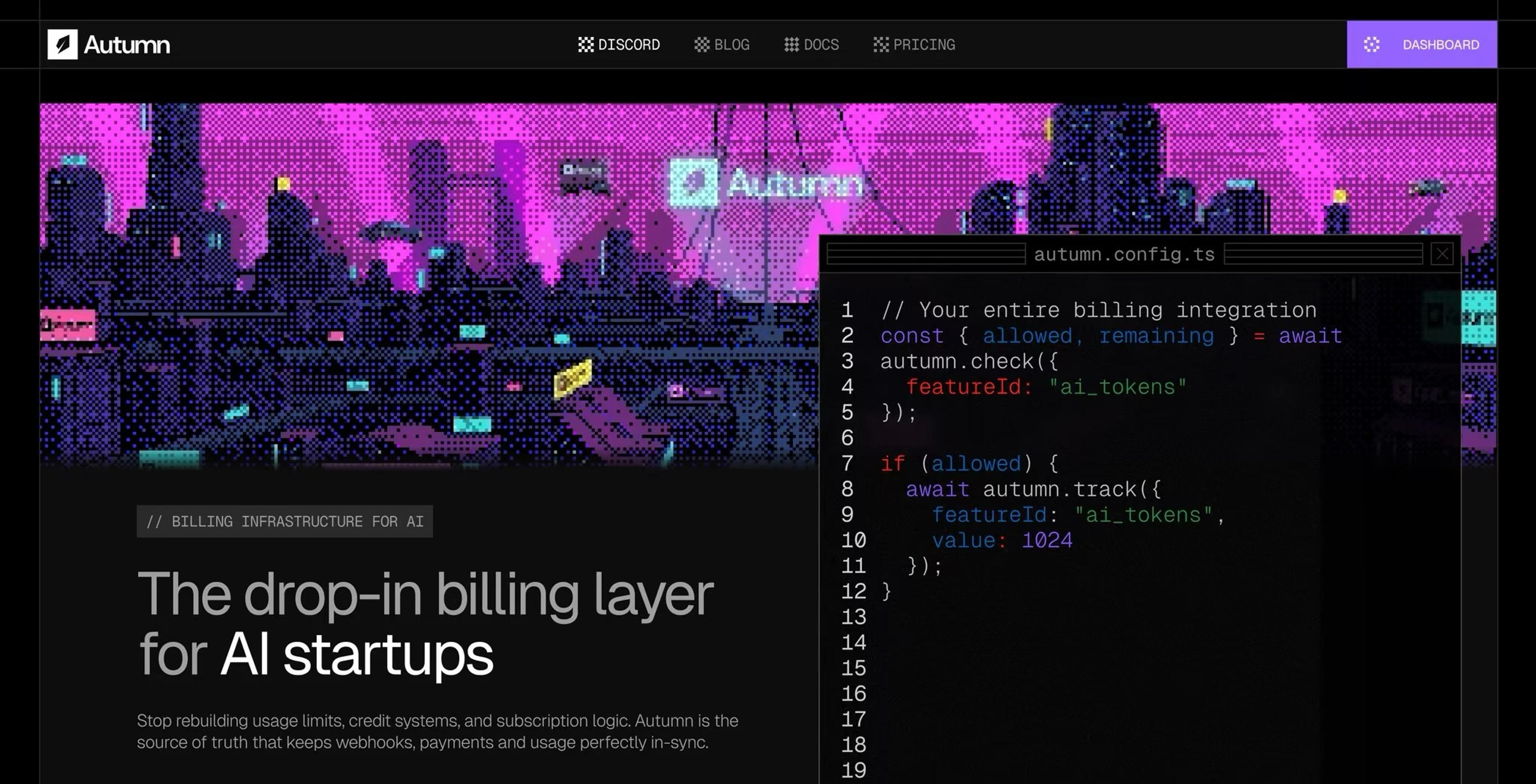
Autumn merged our Next.js code into its own open-source repository.
We designed and built Replay's site in Next.js and moved it into Replay's GitHub at launch, where Replay's team hosts and extends it. Marker's site we built in Astro.
You get 10 days of dev support after launch and recorded walkthroughs of every tool we used, so your team takes over. Other studios that build these sites: best SaaS web design agencies.
How we know: 38 projects for funded B2B and AI-native startups. Of the 17 website projects we finished from September 2025 to October 2026, 7 shipped on Webflow and 6 in custom code. Clients rate us 5.0 across eight reviews on Contra and 4.8 across three on Clutch, and we publish our prices on Contra.
FAQ
How long does a Webflow to Next.js migration take?
A like-for-like move takes 1–5 weeks with a specialist: TechnologyChecker quotes 1 week under 100 pages and 4–5 weeks above 1,000. A full replatform at Webstacks runs 8–12 weeks, and our brand + website projects run 6–8.
How much does it cost to migrate from Webflow to Next.js?
Most specialists publish $1,500–15,000 for a like-for-like move (TechnologyChecker and Webvise, checked November 5, 2026). FocusReactive quotes €15,000–30,000 for a move to a headless CMS. A redesign plus rebuild with PIXELUP LABS starts at $20,000.
Will moving from Webflow to Next.js hurt our SEO?
Not if every URL stays the same or 301s to its new path, with titles, descriptions and canonicals carried over. Rankings can fluctuate for a while, and Google says to keep redirects for at least a year. A redesign or a domain change adds risk: what a website redesign costs, SEO included.
Can we export our Webflow site to Next.js automatically?
No. Webflow's code export leaves out CMS content, forms, localization and site search, and DevLink exports components, not pages. A coding agent such as Claude Code turns the export into React faster than doing it by hand.
Can our marketing team still edit the site after we move to Next.js?
Yes, if content moves to a headless CMS. Sanity, which we use on most builds, gives marketing an editor for pages and posts, free for up to 20 seats. A layout change becomes a prompt to a coding agent.
Can we keep Webflow for the marketing site and use Next.js for the app?
Yes. Webflow Cloud runs a Next.js app under a path on your Webflow domain, such as /app, or the app can live on a subdomain.
Is Next.js better than Webflow for SEO and AI search?
Not by default: 71.3% of Webflow origins pass Core Web Vitals on mobile, against 35.7% of Next.js origins (HTTP Archive, September 2026). Next.js gives you control of metadata, redirects and rendering. Render on the server, because the major AI crawlers don't run JavaScript.
The bottom line
Our prices: Website Sprint from $20,000; brand + website $25–40k, 6–8 weeks; retainer from $6k/mo.
Code got cheap. Design didn't. Move the stack for a few thousand dollars, then spend the real money where enterprise buyers look: book a call.