To do a brand refresh, decide what stays (the name, the argument and the marks buyers recognise), audit every surface a buyer sees, update the system rather than just the logo, brief sales first, then switch every buyer-facing surface on one day. At a funded B2B company the design takes 2–4 weeks, and the product UI follows in normal releases. A Brand Sprint with us is $15k.
You raised, the product grew up, and the brand still looks like the seed round. The instinct is to open Figma. That's the wrong first move: a refresh is decided by what you keep, not by what you draw.
We sell brand refreshes, so read this knowing that. Every step here works without us.
TL;DR: a brand refresh in seven steps
For Series A to C B2B teams whose brand still says the right thing but looks like an earlier company:
| Step | What you decide | Who | When |
|---|---|---|---|
| 1. Set the date and one number | Why now, when everything switches, what you'll measure | One owner | Before kickoff |
| 2. Audit what buyers see | Every surface, next to three competitors | Marketing, two reps | Steps 2–5: 2–4 weeks in a Brand Sprint |
| 3. Decide what stays | Keep, update or replace, element by element | The owner | Same |
| 4. Rewrite the lines | Headline, pillars and proof; the positioning holds | Marketing | Same |
| 5. Update the system | Type, colour tokens, components, templates | Designers | Same |
| 6. Switch on one day | Sales, then customers, then every buyer-facing surface | Everyone | One day; product UI in releases |
| 7. Own it and measure | The system's owner, the step 1 number | The owner | 30 and 90 days after |
Is it a brand refresh or a rebrand?
It's a brand refresh if your argument, your name and your logo all stay, with the logo redrawn at most. A brand refresh updates how a company looks and sounds; the argument is the one claim it makes about its market. Check three things:
- Is that claim still true?
- Is the name staying?
- Is the logo staying, or only being redrawn?
Three yeses: a refresh, and the steps below fit. Any no: a rebrand. Brand refresh vs rebrand walks through that call, and what is rebranding has the rebrand steps.

When does a B2B brand need a refresh?
A B2B brand needs a refresh when it still argues the right thing but looks like an earlier company. The signs we see most:
- The website explains the company you were. Valley "had a brand it liked." Its homepage didn't explain the engine, so prospects kept asking how Valley differed from other LinkedIn tools.
- Sales rebuilt the deck on their own, so the deck and the site now tell different stories. Buyers notice: 69% of 632 B2B buyers in Gartner's 2024 survey found a vendor's website and sellers inconsistent.
- A raise moved you upmarket, and the claim held. Enterprise buyers now meet a brand built for your first ten customers.
- The product outgrew the identity. A second product, an AI feature or an enterprise tier has no place in the system, so each one gets designed from scratch.
- Buyers ask it out loud. 29 of the 83 buyers on our discovery calls asked whether they needed a full rebrand or could refresh the brand and site without changing the logo.
Not a sign: a new executive's taste, or a team that's bored of the logo. Buyers have seen it far less than you have.
How to do a brand refresh, step by step
A B2B brand refresh runs in seven steps, and the first three happen before anyone opens Figma: set the date, audit what buyers see, decide what stays. In a Brand Sprint, steps 2 to 5 take 2–4 weeks.
1. Set the trigger, the switch date and one number
Write down why now: the raise, the move upmarket, the new product line. Then pick the switch date, before any design work. At least 6 of our first 35 projects were timed to a funding announcement or a raise, and at least 7 more to a launch, a rename or a conference.
Pick one number to judge it by, such as demo requests, and log today's value. Give the project one owner, and keep sign-off to one or two people.
2. Audit what buyers see, next to three competitors
Put every surface a buyer meets side by side (the site, deck, product, docs, G2 page and LinkedIn), next to three competitors'.
Mark what buyers already recognise (a colour, a mark, a phrase) and what contradicts the rest. Ask five customers how they describe you to a colleague, and ask your newest rep which slide they skip.
3. Decide what stays
A brand refresh is mostly a list of what you keep. Go element by element: name, argument, logo, type, colour, messaging, website.
Mark each one keep, update or replace. If the logo needs more than a redraw, or the argument needs replacing, stop: that's a rebrand. Valley, an AI outbound platform, kept its brand; we built a new homepage, a product-page template and a sales deck inside it.
The look is often where the work starts, but not always. Across 18 of our projects, the visual identity changed first in 8, the positioning or messaging in 6 and the website in 4.

4. Rewrite the lines, not the positioning
Keep the positioning statement. Change the lines that carry it: the homepage headline, the three or four pillars under it, and the proof under each. After an upmarket move, the proof is what changes: security answers, named customers, a trust page.
5. Update the system, not just the logo
A new logo on an old system starts drifting the day it ships. Update the parts every surface is built from: type, colour tokens, components, the deck, proposal and email templates, and the product UI tokens. Keep the guidelines in the Figma library and tokens your team already uses, not in a PDF.
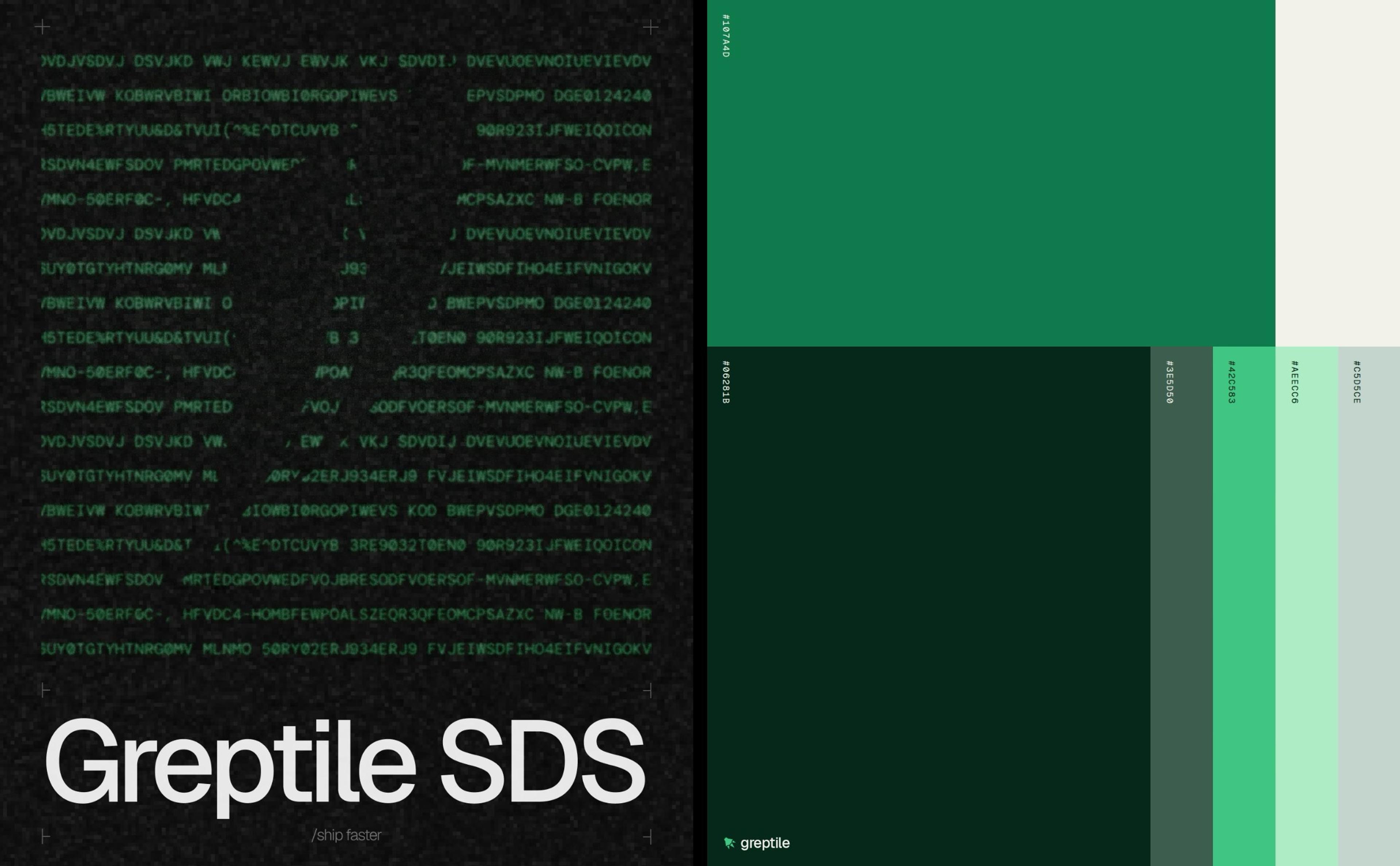
Our 2025 rebrand + design system for Greptile shipped 200+ components. A system like that is what makes a refresh weeks of work: you change tokens, not every file.
6. Brief sales, then switch on one day
Brief sales first, with the new deck and a one-line pitch, then tell customers through channels you own. A refresh rarely needs a press push.
Then switch every buyer-facing surface on one date: the site, the deck, G2, LinkedIn and your directory profiles. The product UI follows in normal releases behind the new tokens, so product work never stops. Swap ad creative the same day, so demand gen keeps running.
Update the profiles AI answers read. Review sites (38%) and AI chatbots (37%) top the sources that shape B2B software shortlists in G2's June 2026 survey of 1,038 decision-makers, and G2 runs a review site.
7. Give the system an owner, then measure
Name one person who owns the system after launch, or the surfaces drift apart again. Check the step 1 number at 30 and 90 days. If you're refreshing every year, the problem is the positioning, not the look.
The B2B brand refresh checklist
A B2B brand refresh reaches far beyond the logo and the homepage. Switch the first group on launch day, the second within 30 days, and the product as it ships.
| Surface | What changes | When |
|---|---|---|
| Website | Homepage, product pages, share images, favicon | Launch day |
| Sales deck, proposals, one-pagers | Master templates, case-study slides, the one-line pitch | Launch day |
| G2, Clutch, LinkedIn, Crunchbase | Logo, banner, screenshots, company description | Launch day |
| Ads, social templates, email signatures | Creative and templates | Launch day |
| Docs, trust page, investor deck, careers page | Logo, colour, screenshots, templates | Within 30 days |
| Product UI and product emails | Colour and type tokens, icons, templates | In product releases |
| Events, booths and merch | Everything printed | Last: the longest lead times |
How did B2B companies run their brand refresh?
B2B companies mostly ran their brand refresh in-house with a studio beside them, and kept one recognisable thing on purpose.
| Company | Who ran it | How long | What stayed | How it rolled out |
|---|---|---|---|---|
| Twilio, 2025 | In-house: "we did this internally" | "only three months" to the direction | The logo: "you can't touch the logo" | Website first, then its SIGNAL event |
| Atlassian, 2024 | With Pentagram | December 2022 to its Team '24 debut | Not stated | In stages ("pardon our dust") |
| Figma, 2024 | Its Brand Studio, with Grilli Type and OH no Type | "months of collaborative exploration" | Its purple | Not stated |
| Miro, 2023 | AKQA with Miro's brand team | Not stated | The yellow and the M, refined | Website first; the product "very much the same" |
| Slack, 2019 | In-house, with Pentagram | Not stated | The octothorpe, per Pentagram | Logo first, the rest "over the next few months" |
Sources: Twilio's podcast, Atlassian, Figma, Miro, Slack and Pentagram.
Big companies phase it. That's right at Atlassian's size. A Series A company has one site, one deck and a few profiles, so phasing just means a buyer sees two brands in one deal.
Which of these were really rebrands: brand refresh vs rebrand.
Mistakes that turn a refresh into a rebuild
Three mistakes turn a brand refresh into a rebuild:
- Refreshing into your category's look. "Modern" usually means looking like the leader.
- Changing the argument by accident. A new tagline that makes a new claim is a rebrand on a refresh budget.
- A half-switch. A new site and an old deck in the same deal shows a buyer two companies.
When not to refresh, and when you don't need us
Don't refresh if the argument stopped being true, the product or the pipeline is the real problem, or you're still finding product-market fit. Wait if enterprise deals are open this quarter and you can't switch every surface at once.
You don't need us if you have a designer and a design system. Figma's Brand Studio led its 2024 refresh, and Twilio's CMO said of its 2025 one, "we did this internally." If only the colour and type change, a freelancer is cheaper: agency vs freelancer.
Who shouldn't hire us:
- You need a new name. We don't name companies. C42D leads naming "from strategy to screening," and Metabrand lists naming under strategy.
- A committee, a merger or several brands to align. Focus Lab covers mergers, acquisitions and "internal alignment across large executive teams." Its Structural Rebrand starts at $25,000/month for three to five months (checked November 10, 2026).
- You're pre-PMF. Use a template until the product finds its buyer.
If none of that is you, book a call.
Who should run your brand refresh?
Your own team should run a brand refresh if you have a designer and a system. A studio fits when the refresh has to reach the site, deck and product by a fixed date.
That's the job we do. A Brand Sprint is $15k and takes 2–4 weeks; brand + website is $25–40k and 6–8 weeks; a retainer from $6k/mo keeps the system from drifting. Other studios' refresh prices are in the brand refresh vs rebrand cost table.
How we know: we're a ten-person studio with 38 projects for funded B2B and AI-native startups. Clients rate us 5.0 across eight reviews on Contra and 4.8 across three on Clutch. SynthioLabs wrote on Contra: "They not only get timelines (a rarity!) but truly understand the vision and story we, as founders, want to tell."
FAQ
What is the first step in a brand refresh?
The first step is setting the switch date and the one number you'll judge the refresh by, before any design. Then audit every surface buyers see, next to three competitors.
How do you announce a brand refresh?
Tell your team first, then customers, then everyone else, through channels you own. Twilio took its 2025 refresh to its website first, then its SIGNAL event; a refresh rarely needs a press release.
Can you refresh a brand without pausing product work?
Yes. The design runs alongside product work for 2–4 weeks, and the product UI picks up the new tokens in normal releases.
Do you need new brand guidelines after a brand refresh?
You need updated guidelines, not a new book: the Figma library, the tokens and the templates your team already opens. Retire the old files on launch day.
How do you measure whether a brand refresh worked?
Check the number you logged before you started, such as demo requests, at 30 and 90 days. Fewer "what do you actually do?" questions on sales calls is the early sign.
The bottom line
A brand refresh is a list of what you keep, a system update and one switch date. Get those three right and it takes weeks, not quarters. See our prices on Contra or book a call.