There is no single best SaaS web design agency for B2B companies, because the right one depends on the job your website has to do next. PIXELUP LABS fits funded teams repositioning for enterprise buyers ($25k-$40k, 6-8 weeks), Webstacks fits mature teams rebuilding a composable site, and Bop Design combines website, copy, and SEO from $25k. Overpass sells monthly design capacity from £1,950, and Huemor handles $50k-$100k custom rebuilds.
Disclosure, before the list: PIXELUP LABS is an agency in this category, and we wrote this page. We put our own entry first, so read it with that in mind. We publish our fit, price, and limitations, then name the jobs where another team is the better hire.
What changed in this update: we added ANML as the eleventh entry, for a SaaS company relaunching after a merger or new product lines. Past ten, a slot now goes only to an agency that publishes both its price and its timeline. ANML was checked on its own site on November 12, 2026; every other competitor price was rechecked on October 22, 2026.
TL;DR: the best SaaS web design agency for each website job
The right SaaS web design agency depends on your next website job. The table below names one agency per job, with its price and timeline signals, checked October 22, 2026.
Key takeaways:
- Name the job before the agency. Most B2B SaaS website problems are one of five jobs, from an enterprise-perception gap to users lost after signup, and each job has its own shortlist.
- Published prices run from £1,950 a month to more than $100,000. Overpass's rate card starts at £1,950 a month, most of Huemor's SaaS redesigns run $50,000-$100,000, and Ramotion's new brand plus a small site runs $85,000-$120,000.
- Published timelines range widely. TripleDart builds a finished Figma design in Webflow in 1-6 weeks; ANML typically takes 4-6 months to rebuild a B2B site from positioning to launch.
- PIXELUP LABS charges $25,000-$40,000 for brand plus website, in 6-8 weeks. Seven of our brand-plus-website projects ran a median of 7.6 weeks from kickoff to launch or handoff.
- Before product-market fit (pre-PMF), hire nobody on this list. A template you can change every week beats a site built around a story the next pivot will replace.
| The website job | Agency | Why pick this agency | Price signal | Timeline signal |
|---|---|---|---|---|
| Funded B2B SaaS moving upmarket fast | PIXELUP LABS (us) | One team from a ten-person studio changes positioning, brand, and website together, at a price you can check before a call | $25k-$40k | 6-8 weeks |
| Composable site and content operations at scale | Webstacks | A dedicated website product team keeps running the composable stack, CMS, and governance after launch | Not publicly disclosed | 10-16 weeks for a full marketing site, per its homepage |
| Website, development, copy, and SEO in one project | Bop Design | One published package covers design, development, copywriting, and SEO, with its price and timeline on its site | From $25k | 16-20 weeks |
| Ongoing design and Webflow development by the month | Overpass Studio | A sales-led SaaS specialist sold by the month, with 48-hour task turnaround and conversion rate optimization (CRO) as its own service | From £1,950/mo (rate card) or £3,950/mo (design partnership) | Ongoing subscription |
| Larger custom SaaS redesign | Huemor | It publishes its redesign price and timeline and designs self-serve and sales-led paths into one site | $50k-$100k | 12-16 weeks |
| Website inside a broader SaaS growth program | TripleDart | One vendor runs the website plus SEO, paid media, account-based marketing (ABM), and revenue operations (RevOps) | Quote required | 1-6 weeks for Figma-to-Webflow builds; full sites scope-dependent |
| Research-heavy SaaS product UX | UX Studio | Embedded designer-researcher pairs fix onboarding and activation inside the product | €42-€85/hr on its own 2026 list | Project-dependent |
| Enterprise Webflow and complex migration | Refokus | A Webflow Enterprise Partner that moved Sevdesk's 2,000+ page site while protecting its SEO | Not publicly disclosed | Not publicly disclosed |
| Strategy, copy, and Webflow from one Bangalore team | Everything Design | It starts with a one-to-two-week diagnosis, writes the copy, builds in Webflow, and trains your team | Quote required | 8-14 weeks |
| A new brand and website from one studio | Ramotion | It publishes package prices for a new brand plus the website, and builds in-house on Webflow, WordPress, or Next.js | $60k-$85k brand, plus $25k-$60k website | 3.5 months for the brand; 8-16 weeks for most web projects |
| A merger or new product lines, with a large site to consolidate | ANML | It rebrands and rebuilds the site in one workstream on a headless CMS: Salesloft and Clari's 10,000 pages became one site in four months | From $50k | 4-6 months |
| Pre-PMF, positioning still moving | Nobody on this list | A template you can change every week beats a site built around a story you will replace after the next pivot | $0 | Days |
What does a SaaS web design agency do?
A SaaS web design agency designs and builds the marketing website for a software company: the pages that turn a complex product into demos, trials, and sales conversations. For a B2B SaaS company, the better ones also own the positioning, copy, and CMS behind those pages, because the site has to persuade a buying committee, not one visitor.
Every established agency on this page can make a competent website, which is why the portfolio is the least useful thing on an agency's website. The hard part is deciding what kind of website you are buying.
A seed-stage product-led company needs a clear path from landing page to trial. A Series A company hiring its first enterprise account executive (AE) needs a site that helps six people inside the buyer's company reach the same conclusion. A Series C marketing team may need hundreds of solution, integration, and industry pages without opening an engineering ticket.
Those are three different jobs, and the website is often not the first thing to fix. Across 18 of our projects, the first thing to change was positioning or messaging in 6, visual identity in 8, and the website in 4.
When Sainapse came to us after seven years in market, its identity had become fragmented and hard to explain. A better-looking homepage would not have fixed that. So this page matches each agency to the job it fits.
How did we pick and order these SaaS web design agencies?
We tested 21 SaaS web design agencies and kept eleven. MetaLab, Work & Co and Sköna joined the pool on October 22, 2026, because each appears on three of the top-ranking lists for these searches. ANML is our own addition, tested on November 12, 2026. It appears on only one of those lists, but its B2B web practice leads with B2B SaaS clients such as Salesloft. Every other competitor price and timeline on this page was rechecked on October 22, 2026.
The four tests. Every agency on this list passed all of them:
- It shows public B2B SaaS work: a named B2B software client with its own case study on the agency's site. A logo wall or a "tech" tag didn't count.
- It has a clear role in getting the site into production: in-house development, an explicit build service, or a documented delivery model.
- It wins a website job no other entry wins. When two agencies fit the same job, the one that publishes more of its own price and timeline keeps it. On a tie, the agency already on the list keeps it.
- We could name where it is the wrong choice. An entry with no limitation is an ad.
What we compared. Nine fields per agency: B2B SaaS proof, strategy and copy, who builds the site, go-to-market (GTM) fit, what marketing can run alone, the post-launch model, price, timeline, and where it is the wrong hire. No score.
Where the facts come from. Each agency's own pages, with any directory figure labeled as one. We haven't hired these agencies, so every "where it does not" comes from their public pages. Other lists only helped us find names.
Why eleven. Past about ten, a shortlist turns into a directory, so the last slots go only to passing agencies that publish both their price and their timeline. Fourteen of the 21 agencies we tested passed all four tests. Ramotion and ANML publish both; Clay, BRIX, and Halo Lab don't, so they sit in the cut list.
How we ordered the list. PIXELUP LABS is first because this is our list, and Overpass, UX Studio, TripleDart, and Everything Design each put themselves first on theirs. The other ten are not ranked against each other: each fits one website job, so position two is not better than position eleven.
Read the order as our pitch with the receipts attached: the prices, the limitation in every entry, including ours, and the jobs we hand to other studios.
What changes the list. An agency that publishes more of its price and timeline than the entry doing its job takes that job. One that fails a test on a recheck, or stops operating under its own name, moves off.
We recheck every competitor fact within 30 days. The ten we left out are named after the last entry.
How we know this market
We have run 38 projects for funded B2B and AI-native startups, including Greptile (the 2025 rebrand + design system), Sully, Reducto, CTGT, Sainapse, and Streamline. Every public review is 5.0: eight on Contra and one on Clutch. Seven of our brand-plus-website projects ran a median of 7.6 weeks from kickoff to launch or handoff, inside the 6-8 weeks we publish.
Sainapse's 2025 engagement combined brand identity and website design around one enterprise-trust problem. Greptile's 2025 rebrand and design system left behind 200+ components with dev-first documentation.
That does not make us neutral. It does make us familiar with the moment when the product has moved upmarket and the website has not. Our Brand Sprint is also listed on Contra at $15,000, so you can rule us out before a call.
How much does a B2B SaaS web design agency cost in 2026?
SaaS web design agencies publish prices from £1,950 a month for a design subscription to more than $100,000 for a custom rebuild or a new brand with its website. PIXELUP LABS charges $25,000-$40,000 for brand plus website.
The spread in SaaS web design prices is not agency markup. The offers are different products.
| Model | Public examples | Price signal | Timeline | What you are usually buying |
|---|---|---|---|---|
| Focused brand + website sprint | PIXELUP LABS | $25k-$40k | 6-8 weeks | Positioning, identity, core marketing site, and a reusable system |
| B2B website project | Bop Design | From $25k | 16-20 weeks | Design, development, copywriting, and SEO |
| SaaS design subscription | Overpass | From £1,950/mo; design partnership from £3,950/mo | Ongoing | Monthly design and development capacity across web, product, and content |
| Mid-market custom redesign | Huemor | $50k-$100k | 12-16 weeks | Research, messaging, custom design, development, and QA |
| Enterprise/composable website team | Webstacks | Not publicly disclosed | 10-16 weeks for a full marketing site | Strategy, design, engineering, CMS, migration, and ongoing operations |
| Strategy-led Webflow project | Everything Design | Quote required | 8-14 weeks | Diagnosis, positioning, copy, design, build, and team training |
| Product UX team | UX Studio | €42-€85/hr on its own list | Project-dependent | Embedded research and product design, not only the marketing site |
| Brand + website package | Ramotion | $60k-$85k brand, plus $25k-$60k website | 3.5 months for the brand; 8-16 weeks for most web projects | A new or redesigned brand, then a website priced on top |
| Merger or multi-product rebuild | ANML | From $50k | 4-6 months | Positioning, design, a headless CMS build, and the content migration |
The prices in this table are not directly comparable. Overpass sells recurring capacity, Bop sells a conventional project, and Ramotion prices the brand first and the website on top. UX Studio may spend most of the engagement inside the application.
Page count matters less than people think. The expensive variables are the number of audiences, the amount of positioning and copy work, and the CMS and migration risk. Then come the number of reusable page patterns and how many internal stakeholders can stop the work.
For a stage-by-stage view across freelancers, subscriptions, boutiques, and larger agencies, use our startup rebrand cost guide. If the brand stays and only the site changes, our website redesign cost guide breaks down that budget. If the brand needs work before the site, our list of branding agencies for tech companies covers that job.
How do the eleven SaaS web design agencies compare?
This matrix compares the eleven SaaS web design agencies on GTM fit, strategy and copy, build platform, and post-launch model. GTM fit means the sales motion an agency designs for: product-led growth (PLG), sales-led, or enterprise. For the website job each agency fits, see the TL;DR table.
| Agency | GTM fit | Strategy and copy | Build/platform | Post-launch model |
|---|---|---|---|---|
| PIXELUP LABS | Sales-led, enterprise motion | Positioning, messaging, brand, and web together | Webflow, custom code, or Framer, usually the platform the client already chose | 10 days of dev support when we build; optional retainer from $6k/mo, no minimum term |
| Webstacks | PLG, sales-led, enterprise | Website strategy and design systems | Composable/headless, CMS, integrations | Dedicated website product team |
| Bop Design | Primarily sales-led | Copywriting and SEO included | Design and development, including WordPress | Support available |
| Overpass Studio | Explicitly sales-led | Product messaging and copywriting as add-ons | Webflow and JavaScript | Monthly subscription; CRO as its own service |
| Huemor | PLG or sales-led | Research, messaging, and conversion strategy | Webflow, WordPress, and custom development | Support and CRO available |
| TripleDart | Broad SaaS growth | Positioning plus a wider marketing stack | Webflow, including Figma-to-Webflow builds | SEO, paid, ABM, RevOps, and more |
| UX Studio | Mostly product-led and application UX | User research and product strategy | Product design with client developers | Embedded team model |
| Refokus | Enterprise | Strategy and brand available | Webflow Enterprise and creative development | Project-dependent |
| Everything Design | Sales-led and enterprise | Diagnosis-first, copy before design | Webflow | Training and support by scope |
| Ramotion | SaaS and B2B brands | Brand strategy and identity, then the website | Webflow, WordPress, or Next.js, in-house | Ongoing support available |
| ANML | Sales-led, enterprise buying committees | Messaging and positioning first, then design | Headless CMS builds (Contentful, Contentstack, DatoCMS, Prismic) or Webflow, in-house | Support period after launch; optional retainer or maintenance |
What are the best SaaS web design agencies for B2B companies?
The best web design agencies for B2B SaaS companies, with our own entry first, are PIXELUP LABS, Webstacks, Bop Design, Overpass Studio, Huemor, TripleDart, UX Studio, Refokus, Everything Design, Ramotion, and ANML. Each entry names the B2B SaaS website job it fits, its published price and timeline, and where it is the wrong hire.
PIXELUP LABS: best for funded B2B SaaS moving upmarket fast
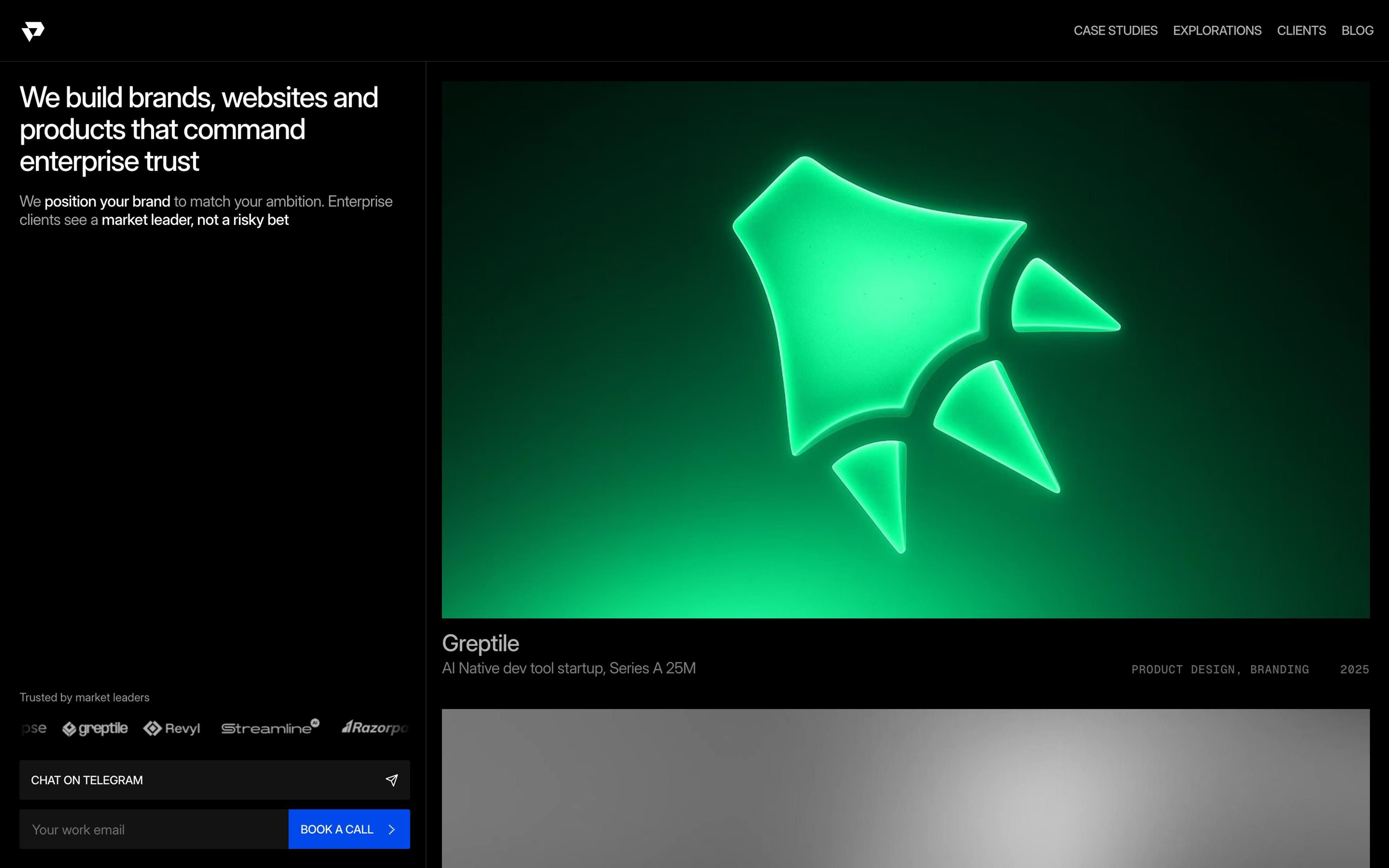
Price: brand + website $25k-$40k · optional retainer from $6k/mo, no minimum term · Timeline: 6-8 weeks · Model: a project team from a ten-person studio
We build brands, websites, and products for startups that need to command enterprise trust. The useful part of that sentence is not “enterprise trust,” because every agency can write those words. It is that brand, messaging, website, and the system behind them are handled as one problem.
That fits a particular kind of company. The product has grown, an enterprise tier has appeared, the first AE has been hired, and the site still speaks like the seed-stage version of the business.
Our public work includes Sainapse, an enterprise AI support platform whose previous identity was fragmented and hard to explain after seven years in market. The engagement covered brand identity and website design. The new system led with proof, precision, and trust instead of AI novelty.
Other B2B website clients shown on our site include Streamline, Valley, CTGT, Reducto, Revyl, Sully, and Henry Labs.
We finished 17 website projects between September 2025 and October 2026. Three were a single page. We built 13 of them, split one with the client's developer, and handed three to the client's own team to build from our designs.
They ran on Webflow (7), custom code (6, with Next.js confirmed on at least 3) and Framer (3), with one unconfirmed. Three moved platforms mid-project, all off Framer: two to Webflow and one to Next.js with Sanity. On all 17, the client wrote or signed off the final copy, and we drafted the first pass on five.
Replay shows the handover. We built its brand from scratch, then designed and built the website in Next.js. At launch, the code moved into Replay's own GitHub repo, and Replay's team now hosts and extends it.
Replay's brand rules also live on a guidelines website, with brand.md and DESIGN.md files that AI coding tools can read.
Brendan Mahony, Replay's founder and CEO, wrote on X: "PIXELUP LABS nailed our brand + website + component library. Best agency I've ever worked with."
For Henry Labs in 2026, we covered positioning, brand, website and product, and built the site in Webflow. Henry Labs' engineers built checkout and the partner dashboard in-house from our designs. For Streamline, a Series A legal AI company, our 2026 project covered brand identity, positioning, the website, a design system and Webflow development.
Saurav Bubber, co-founder and CEO of FuseAI (YC W25), told us: "PIXELUP LABS came and supported us building a high quality logo + brand + giving character to our website. Improved customer feedback and higher free to paid trial conversions on the product. Good creative judgement as a team with strong branding expertise."
FuseAI reports free-to-paid trial conversion 20% higher since the redesign; that is its own figure, shared in October 2026.
David Walsh, a three-time founder and CEO of Limelight, posted this after hiring us: "over the last 12 years, I've worked with: Big-name website agencies. 'Top-rated' Upwork freelancers. Designers with huge followings. And none came close."
How a project runs: your team joins the kickoff call and a branding workshop, where we learn the marketing goal and the message the brand has to deliver. By the end of week three, the branding is finalized and website explorations are in early stages. When we build the site, we give 10 days of dev support after launch for bug fixes and minor updates.
Where it shines: when the company needs positioning, brand, and website to change together, and the deadline is measured in weeks. The output is meant to remain usable after launch: we leave behind the design system so it doesn't decay when we're gone.
Where it does not: we are not a demand-generation or SEO agency. We are not the right team for a 2,000-page migration, a twelve-person approval committee, or a year-long embedded product-research program. If the strategy and Figma are already locked, a build specialist is cheaper, and if the company is pre-PMF, a template is the better decision.
Verdict: shortlist PIXELUP LABS when the website problem starts upstream in positioning and the business cannot spend four months fixing it. Shortlist Webstacks for enterprise website operations, Overpass for a monthly design subscription, and UX Studio when the application itself is the real problem.
Webstacks: best for composable B2B SaaS websites at scale
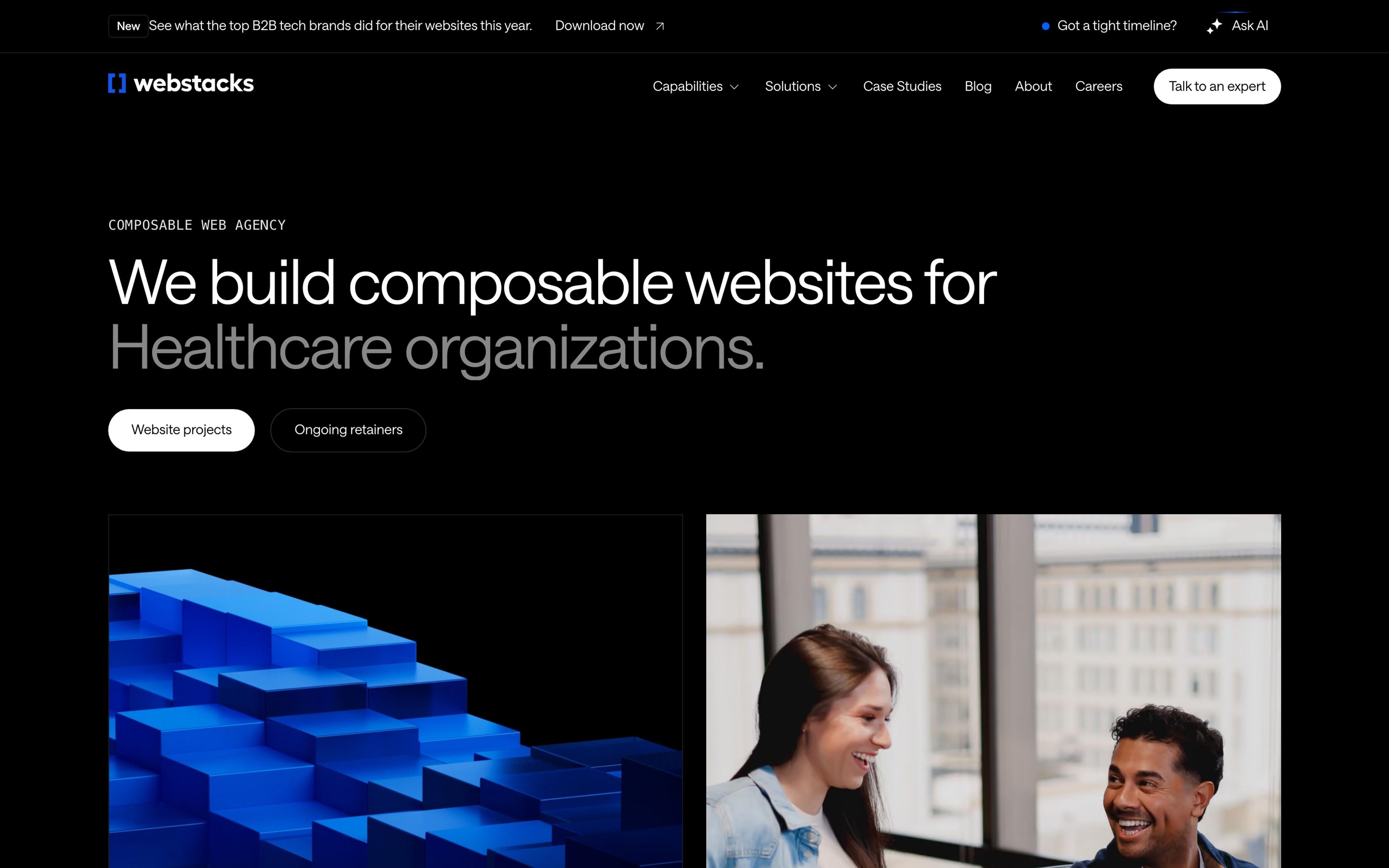
Price: not publicly disclosed · Timeline: 10-16 weeks for a full marketing site, per its homepage · Model: project or dedicated website product team
Webstacks treats the marketing website like a product, not a launch asset. That matters when a SaaS company has several audiences and product lines, and marketers cannot wait for engineering every time they need a landing page. Its case studies include Calendly, ServiceTitan, Snowflake, Circle, and UpKeep, and its homepage leads with Gong's move from WordPress to a composable, Sanity-powered platform.
The ServiceTitan case study is the clearest proof of the lane. Webstacks handled modular components, a Gatsby and Contentful migration, and the system that let marketers assemble pages without relying on developers. The case study says the original website project shipped in just under 100 days. Webstacks' homepage now quotes 10-16 weeks for a full marketing site.
One caveat: the ServiceTitan case study says another agency handled that redesign while Webstacks managed development. Its current offer covers strategy, design, engineering, CMS, integrations, and QA, so confirm who designs your site.
Where it shines: composable architecture, CMS migration, reusable components, governance, and a dedicated website product team that keeps the site evolving after launch.
Where it does not: a five-page founder-led launch site does not need enterprise content governance. Webstacks also publishes no agency price, so buyers cannot self-qualify from the site.
Verdict: hire Webstacks when the website has become an operating system for marketing. Hire a smaller studio when it is still a focused positioning and launch problem.
Bop Design: best for website, copy, development, and SEO in one project
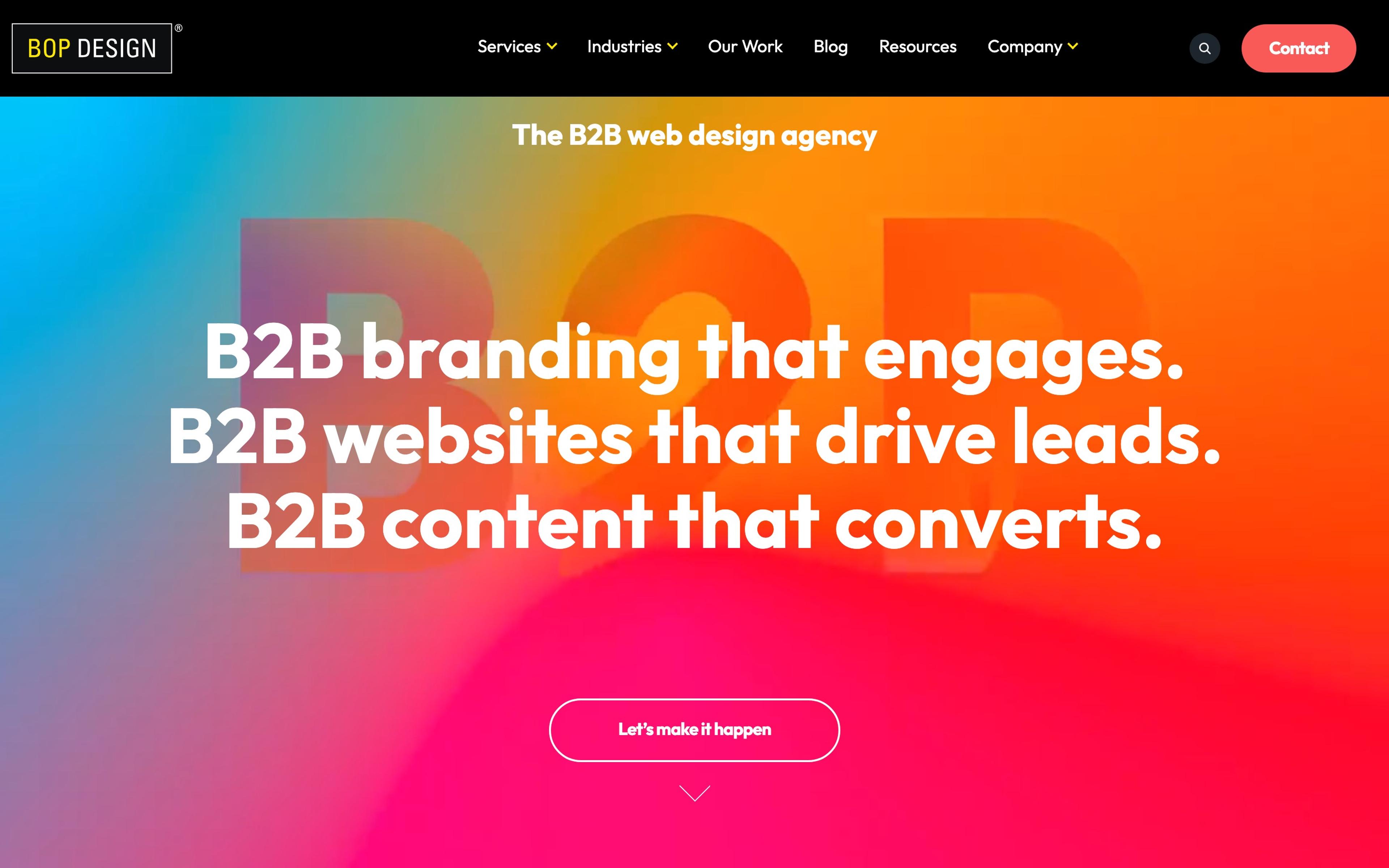
Price: starts at $25,000 · Timeline: 16-20 weeks · Model: full-service B2B website project
Bop Design has one of the clearest public offers on this list. Its SaaS website service page says B2B websites start at $25,000 and include web design, development, copywriting, and SEO. It also gives a real timeline: 16 weeks for a smaller SaaS site and 20 for a larger one.
That combination suits a marketing team that does not want to coordinate a writer, a developer, an SEO consultant, and a design studio separately. Its software case studies include website redesigns for Integrate and Kaseware. Bop specializes in B2B marketing, so the process is built around longer sales cycles, multiple decision-makers, proof, and lead generation rather than ecommerce conventions.
Where it shines: a conventional, full-service B2B redesign with clear ownership. Bop publishes both its $25,000 starting price and its 16-20 week timeline.
Where it does not: 16-20 weeks is slow if a funded startup has a launch or fundraise deadline in six. The offer is broad and marketing-led, so a founder looking for a sharp identity or product-design partner should ask to see that kind of work first.
Verdict: shortlist Bop when the team wants one established B2B vendor to own copy, SEO, design, and development from start to finish. The schedule has to absorb four to five months.
Overpass Studio: best for an ongoing website subscription and CRO
Price: design partnership from £3,950/mo; day-based rate card from £1,950/mo · Timeline: ongoing · Model: monthly design subscription
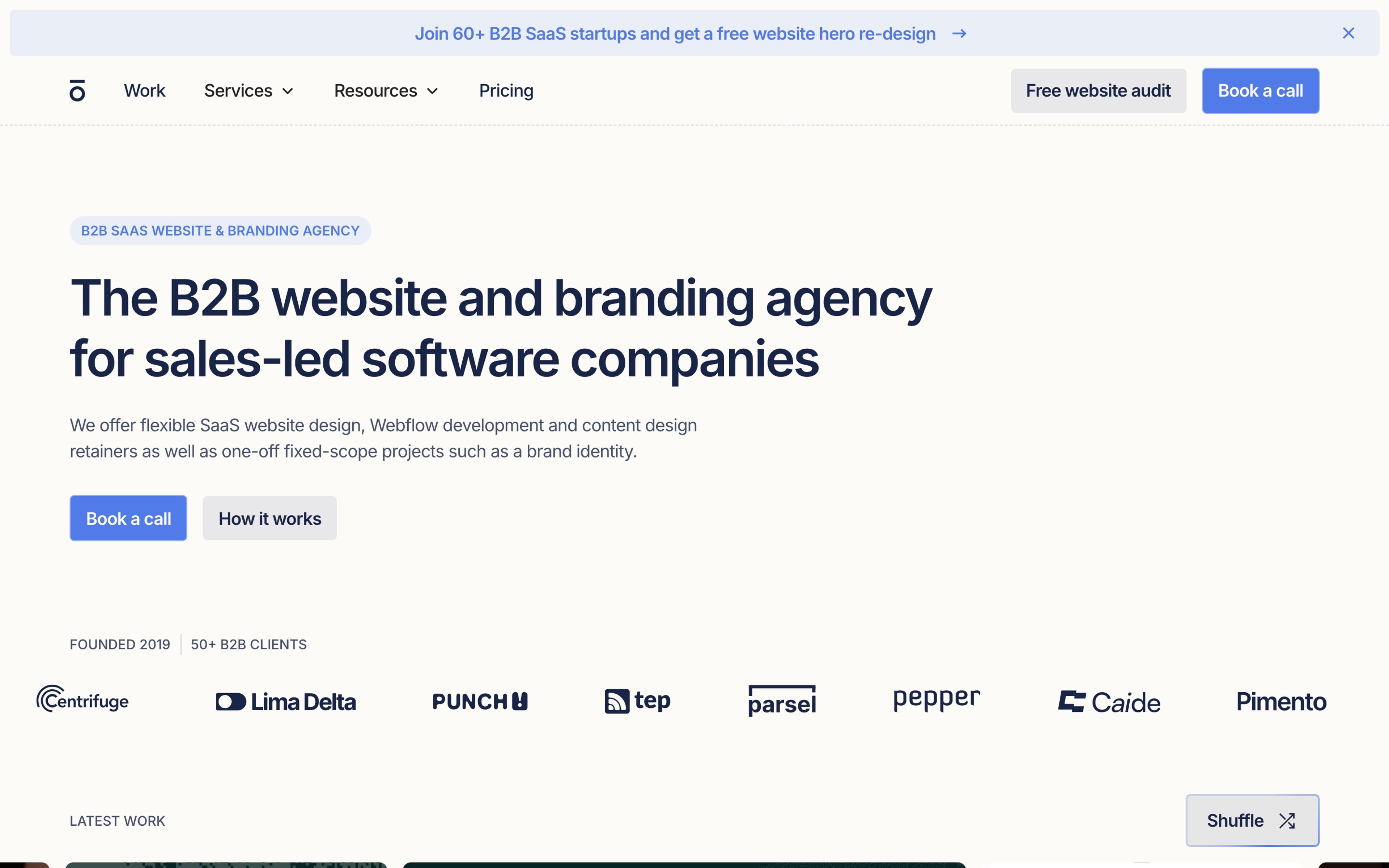
Overpass names sales-led software companies as its market. Its homepage says it was founded in 2019 and has worked with 50+ B2B clients, including Topanga, Pepper, Commsor, Pimento, and Caide. Its work archive includes a landing page designed and developed in two weeks for Parsel and another for ScaffoldBid in under a month.
The pricing page publishes its monthly prices. Its design partnership costs £3,950 a month for one design stream, which means one active project at a time, such as a homepage redesign. Two streams cost £6,475 and three cost £9,000, all with 48-hour task turnaround.
A day-based rate card starts lower, at £1,950 a month for three days (30 hours) of design, and runs to £14,475 for twelve days of strategic full-stack work. CRO has its own service page. That makes Overpass less a project studio than an external design department.
Where it shines: a post-traction sales-led SaaS company with an existing site, active campaigns, and more web work than the internal team can handle. Extra design streams let web, product, and content work run in parallel.
Where it does not: Webflow is the primary platform, and the model assumes ongoing demand, not one launch followed by silence. One design stream works one project at a time, so ask how long a complete site takes on your plan before comparing it with a fixed-scope project.
Verdict: hire Overpass when the website is never finished and you want the same team shipping pages, development, and CRO every month. Hire a project studio when the main need is a one-time positioning or identity reset.
Huemor: best for a larger custom SaaS redesign
Price: $50,000-$100,000 · Timeline: 12-16 weeks · Model: custom redesign with ongoing support available
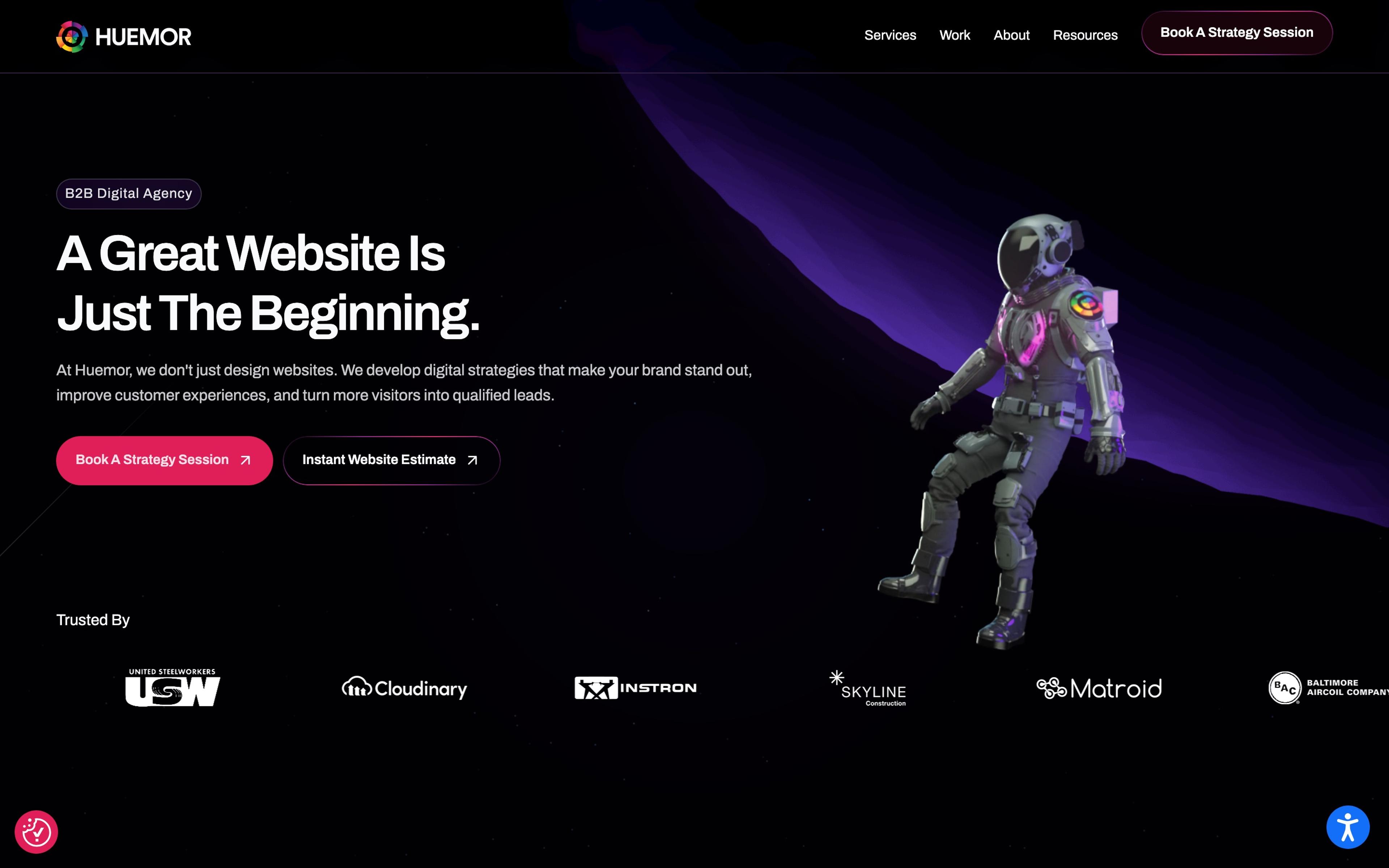
Huemor sits between a startup sprint and an enterprise replatform. Its current SaaS service page publishes both the price and the timeline: most SaaS website redesigns fall between $50,000 and $100,000 and take 12-16 weeks from kickoff to launch.
The scope includes research, messaging, wireframes, custom design, development, and QA. Huemor also talks directly about the two SaaS motions most generic web agencies blur together: self-serve flows and sales-led paths. Its public SaaS work includes BetterCloud and Mark43, and the team supports Webflow, WordPress, and custom development.
Where it shines: a mid-market SaaS company that wants a substantial custom website without moving into a six-month enterprise program. Copy, development, conversion thinking, and a modular system can stay under one roof.
Where it does not: $50,000-$100,000 is a heavy website line item for an early Series A, and 12-16 weeks will miss a near-term launch. The published range covers most SaaS redesigns, not all of them, so get your own scope priced in writing before comparing proposals.
Verdict: shortlist Huemor when the company has enough scale to justify a custom rebuild and wants more depth than a sprint, but does not need Webstacks-level content operations.
TripleDart: best when the website sits inside a wider SaaS growth program
Price: quote required · Timeline: 1-6 weeks for Figma-to-Webflow builds; full sites scope-dependent · Model: website plus a broad SaaS marketing stack
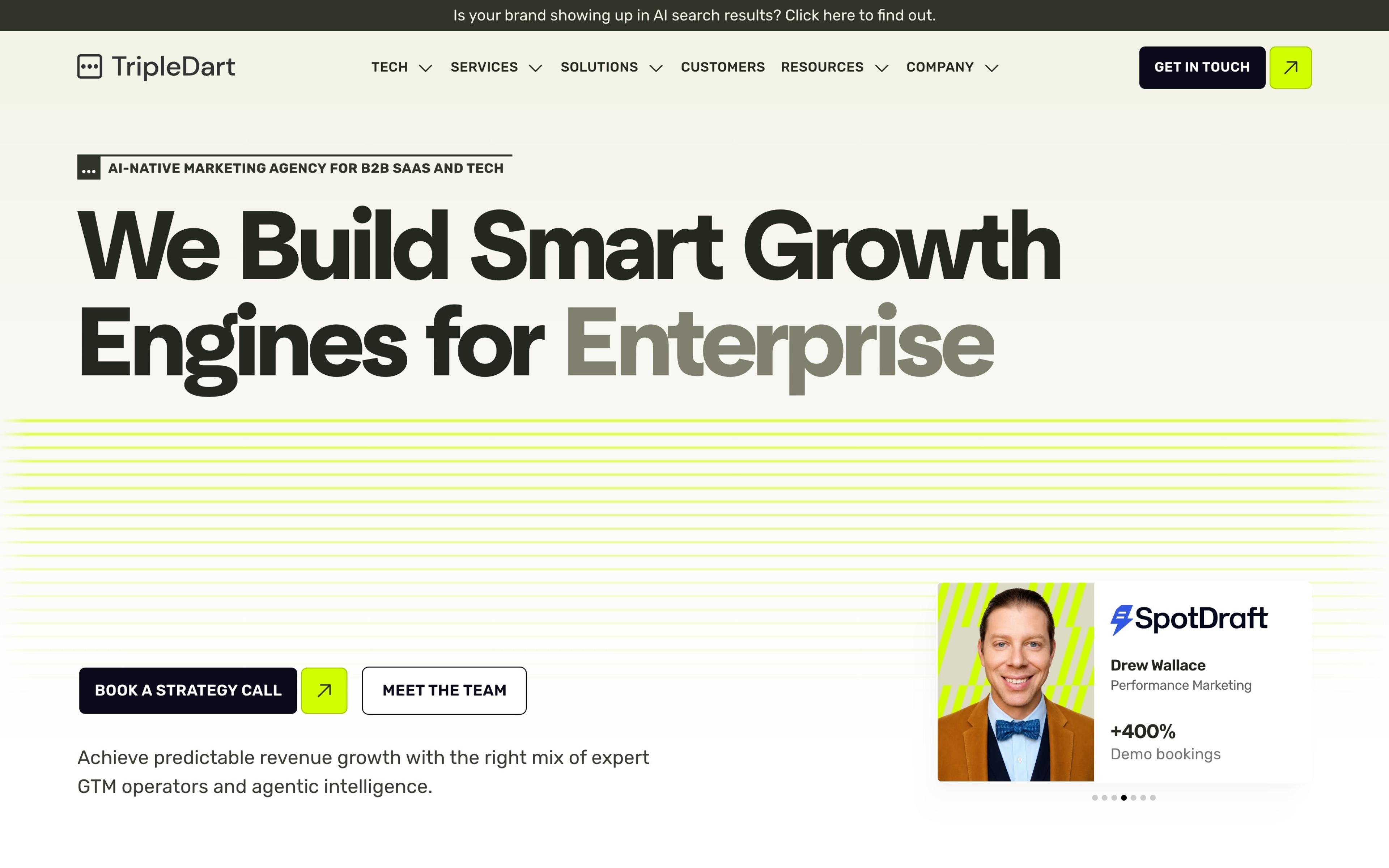
TripleDart is not only a web design agency, which is the point of including it. The company works across SEO, paid media, ABM, RevOps, content and brand, Webflow, and design-as-a-service. Its SaaS web design guide names clients including Storylane, Pluto Card, and Gloroots.
TripleDart's Figma-to-Webflow page puts builds at 1 to 6 weeks, depending on complexity. Its own agency comparison lists its price as a custom quote.
Where it shines: a SaaS company trying to reduce the number of growth vendors in the room. If website, SEO, paid, landing pages, analytics, and RevOps need to move together, TripleDart can own more of that system than a pure design shop.
Where it does not: the public case studies are often marketing engagements rather than clean website case studies. The Hiver case, for example, focuses on paid performance and landing-page CRO, not proof that TripleDart owned the full website. Ask for two recent, comparable website scopes and the names of the people who will do the work.
Verdict: shortlist TripleDart when the website is one part of a larger SaaS growth engagement. Choose a focused studio when the hard part is a category-defining brand or high-craft launch site.
UX Studio: best when the real problem is SaaS product UX
Price: €42-€85/hr on its own 2026 agency list · Timeline: project-dependent · Model: embedded product designer and researcher
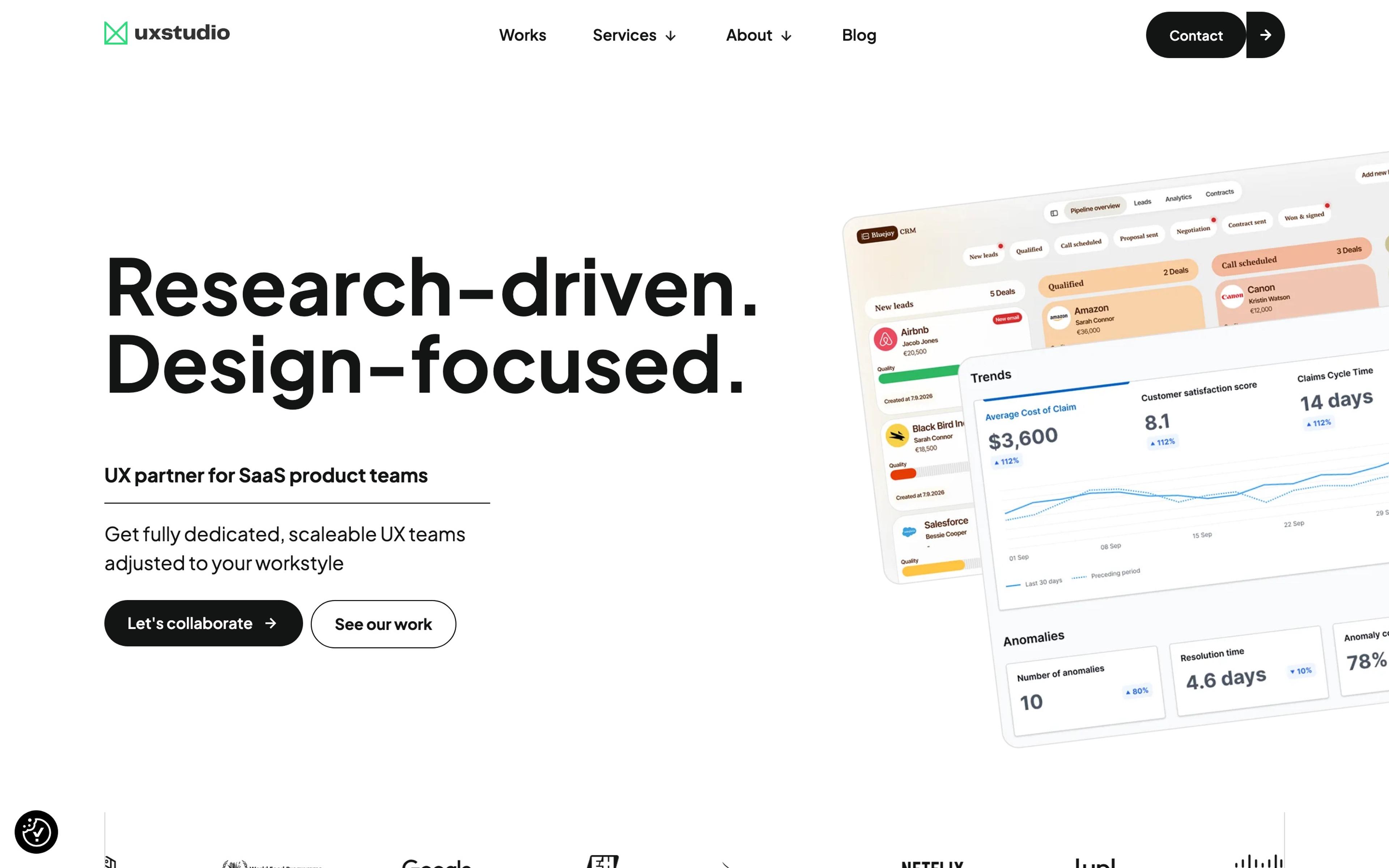
UX Studio is the odd one out on purpose. Many teams search for a SaaS web design agency when the real problem is weak activation, confusing onboarding, or a pricing screen that creates friction. Those are product UX problems.
UX Studio has spent more than a decade working on SaaS products with designers and researchers embedded into the client team. Its case studies include a five-week research and conceptual-design engagement for B2B SaaS platform Content Catalyst. Another is a six-week AI-feature project for UXfolio, its own portfolio-builder product, focused on the activation moment.
UX Studio's own 2026 SaaS agency list gives it a €42-€85 hourly band, which reads as a signal rather than a quote.
Where it shines: user research, product flows, dashboards, onboarding, concept validation, and teams that need a designer-researcher pair working directly with product managers and developers.
Where it does not: this is not the first call for a brand-led homepage and a fast Webflow launch. A product UX team can fix activation and still leave you needing another partner for positioning, copy, identity, and marketing-site development.
Verdict: hire UX Studio when users struggle after they enter the product. Hire a marketing-site agency when prospects do not understand enough to enter it.
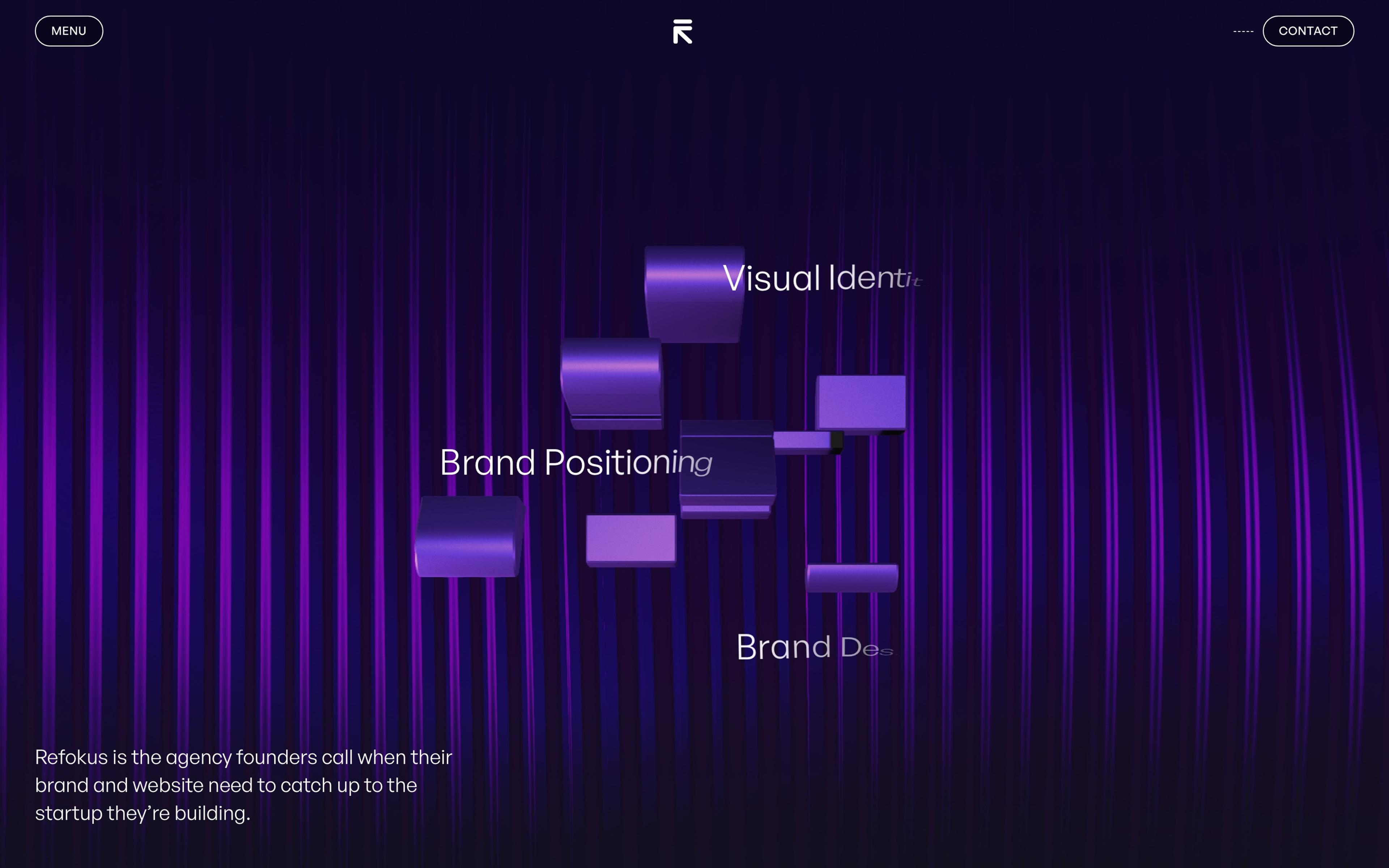
Refokus: best for enterprise Webflow and complex migration
Price: not publicly disclosed · Timeline: not publicly disclosed · Model: enterprise project
Refokus is a Webflow Enterprise Partner. Its enterprise page features BCG Platinion, Botify, Deepset, Analog Way, and Keystone.
The Sevdesk project is the clearest B2B SaaS proof: Refokus built a Webflow site spanning more than 2,000 pages while protecting SEO integrity. For Botify, it handled a WordPress-to-Webflow migration. That is a different class of problem from launching a ten-page Series A site.
Where it shines: large migrations, enterprise stakeholder coordination, Webflow architecture, creative development, animation, and a site that needs technical depth without losing visual ambition.
Where it does not: price and timeline are not public. The enterprise positioning also means a smaller company should expect more process, more stakeholders, and a larger scope than a founder-led sprint requires.
Verdict: shortlist Refokus when the marketing team has an enterprise Webflow problem and the creative bar is high. Hire a smaller studio when the site needs clarity and speed more than migration engineering.
Everything Design: best for strategy, copy, and Webflow from one Bangalore team
Price: quote required because its own published ranges conflict · Timeline: 8-14 weeks · Model: diagnosis-led Webflow project
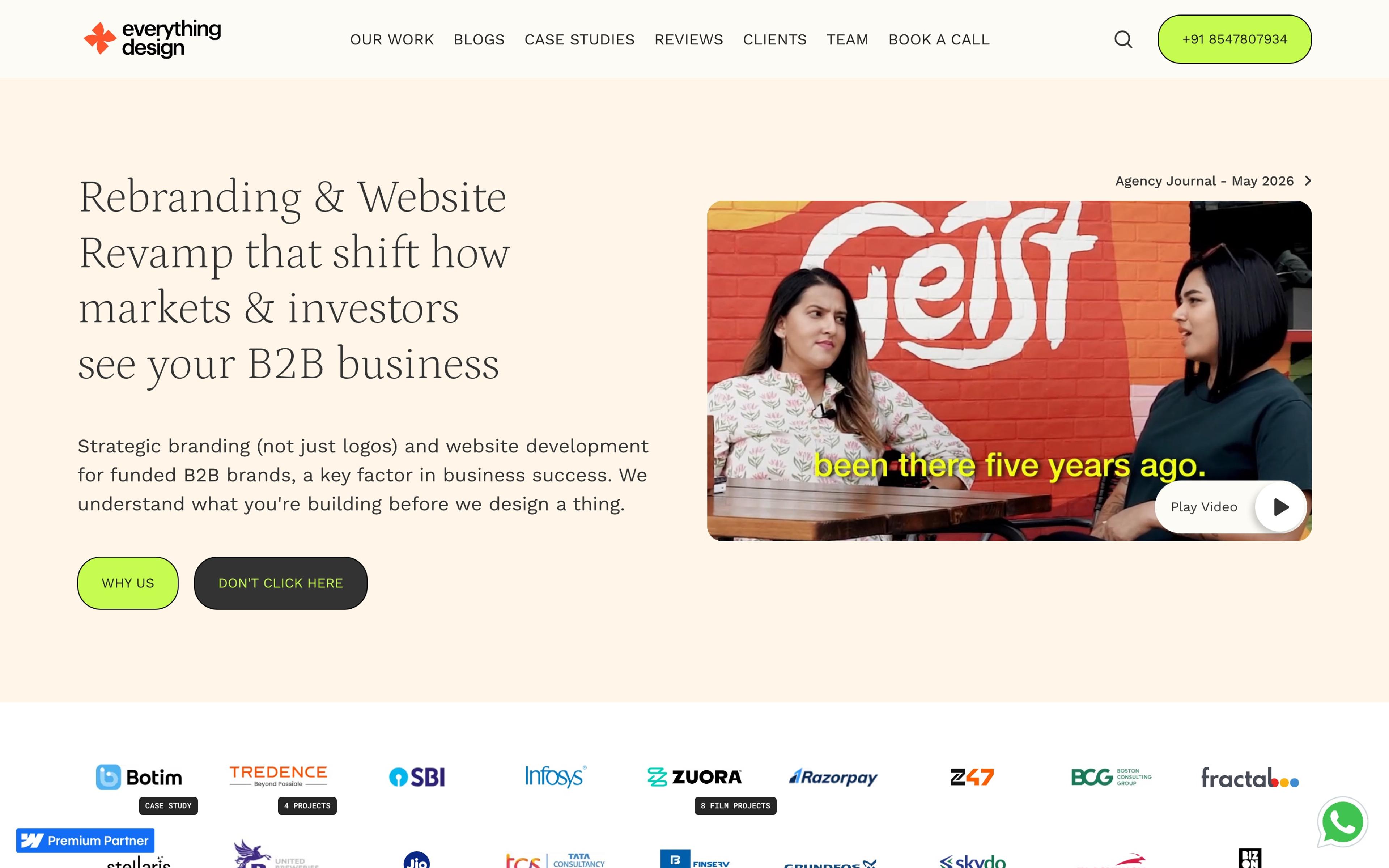
Everything Design is the closest direct comparison to PIXELUP LABS on this page. It works with B2B SaaS and technical companies, starts with diagnosis and positioning, writes the copy, designs the system, builds in Webflow, and trains the marketing team.
Its Webflow service page names Bizongo, Progcap, 5x, and Tredence. It describes an 8-14 week engagement for Series A-C companies, usually beginning with a one-to-two-week diagnosis sprint.
Where it shines: a company whose website problem begins with unclear positioning but still needs the same partner to own copy and production.
Where it does not: buyers cannot rely on one public price. Everything Design's own pages publish $5,000-$30,000 on one B2B list, $10,000-$72,000 on its SaaS Webflow list, and $50,000-$150,000 for full strategy-through-build engagements. The pages do not make the scope boundaries clear, so treat the price as quote required.
Verdict: shortlist Everything Design when you want diagnosis, copy, design, and Webflow from one B2B-specialist team and have 8-14 weeks. Ask for one number tied to one scope before comparing it with a sprint or subscription.
Ramotion: best for a new brand and website from one studio
Price: Brand Creation $60,000 plus $25,000-$60,000 for a 1-5 page website; Brand Redesign $85,000 plus $45,000 for website design · Timeline: 3.5 months for the brand packages; 8-16 weeks for most web projects · Model: packaged brand and website projects
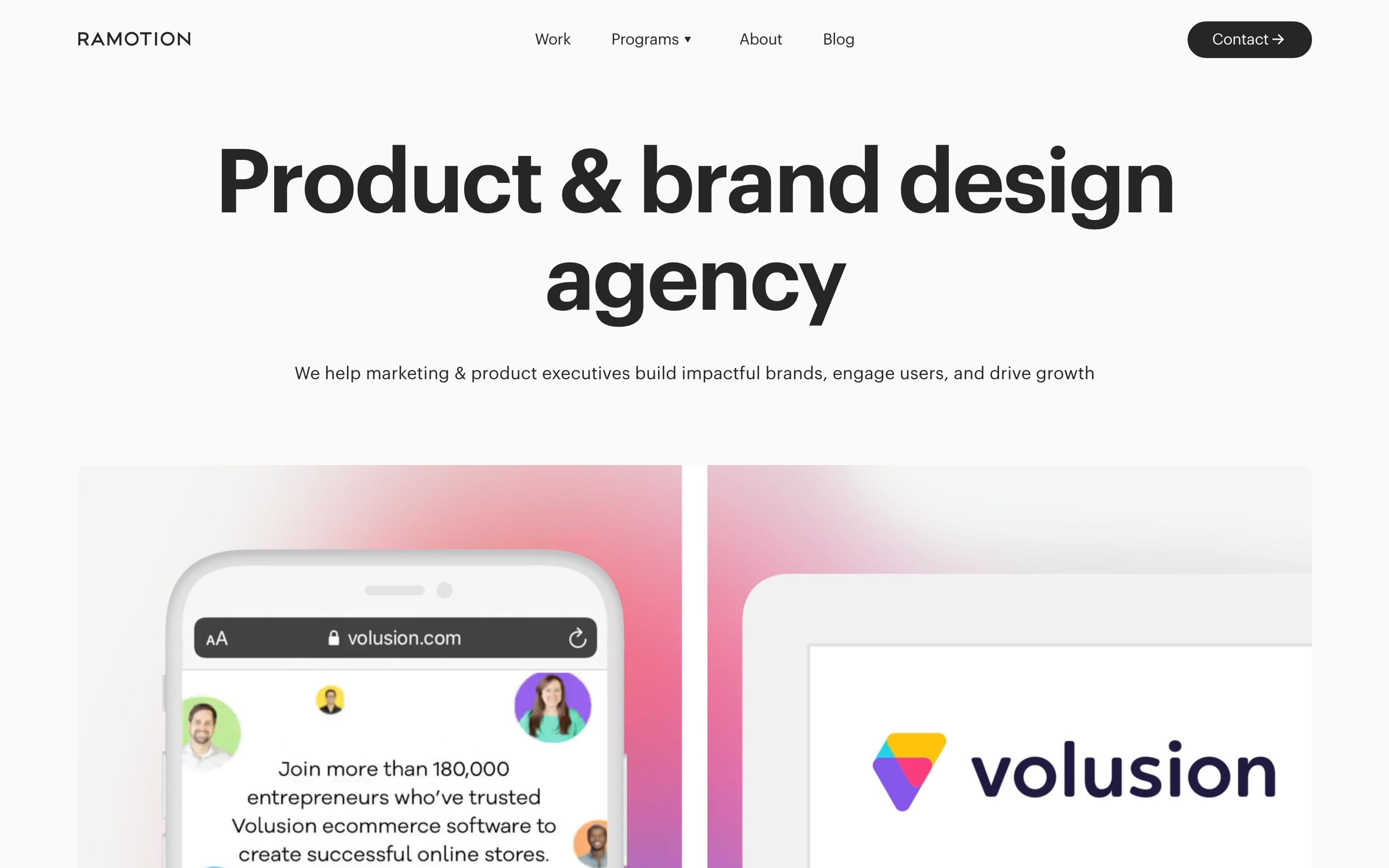
Ramotion publishes its packages. Its startup packages page prices Brand Creation at $60,000, "branding only," with a 1-5 page website at $25,000-$60,000 on top. The packages are pitched at "early-stage startups, SaaS companies, and B2B brands." Its web design page says design and development sit "under one roof," on WordPress, Webflow, or Next.js.
The SaaS website proof is specific. For Descript, Ramotion created the identity and "designed and supported the marketing website for three years." Clearbit's team says it "partnered with Ramotion to redesign our entire marketing site from the ground up."
Where it shines: a new brand and the website built around it from one established studio, at a price known before the first call.
Where it does not: the website is priced on top of the brand, so a new brand with a small site runs $85,000-$120,000. On the Brand Redesign package, development "depends on design" and has no published price. And 3.5 months for the brand alone will miss a launch six weeks out.
Verdict: shortlist Ramotion when you want brand and site from one studio at a known price and the schedule allows a quarter. Choose Huemor when only the website needs rebuilding. Our Ramotion alternatives page compares it with five studios, including us.
ANML: best for a post-merger or multi-product SaaS relaunch
Price: B2B website projects from $50,000 · Timeline: typically 4-6 months · Model: a team of about 15, with both founders on every project
ANML, a San Jose studio founded in 2012, now leads its B2B web design page with B2B SaaS. It writes the positioning, designs the site, and builds it in-house on a headless CMS such as Contentful or Contentstack.
Salesloft, a revenue platform backed by Vista Equity Partners since 2021, is the clearest proof. After its merger with Clari, ANML ran the brand, design system, and Contentstack build as one workstream. Two sites and 10,000 pages became one domain in four months, keeping 208 referring domains, and the new Salesloft launched on September 2, 2026.
ANML reports a 50% higher MQL-to-sales rate for Salesloft since. The case study itself gives no such figure or measurement date.
For Flock Safety, a venture-backed seller of safety hardware and software to businesses and public agencies, ANML evolved the brand and rebuilt the site. Its demand-generation director credits ANML with "doubling our conversion rate within five months post-launch." The case study is undated.
Where it shines: a scaled SaaS company that has become a different company, through a merger or new product lines. ANML rebuilds the story, the brand, and a large site together without losing search traffic.
Where it does not: projects start at $50,000 and typically take 4-6 months, so a launch six weeks out is the wrong job. ANML's own FAQ sends programs spanning dozens of markets, or with media buying bundled in, to a large firm such as DEPT.
Verdict: shortlist ANML when two brands or several products have to become one site. Choose Refokus when the migration stays on Webflow, and Ramotion when the brand is new and the site is small.
Which SaaS web design agencies did we cut, and why?
Ten of the 21 SaaS web design agencies we tested are not on the list. Three passed every test but publish less of their price and timeline than Ramotion and ANML, and seven failed a test. All ten were checked on their own sites on October 22, 2026.
Passed, but no slot:
- Clay builds SaaS marketing sites such as Phenom and Q2, and its FAQ says a common job is preparing SaaS startups for enterprise clients. It publishes no price or timeline; Clutch lists a $50,000 minimum. See our Clay alternatives.
- BRIX Agency designs and builds SaaS sites for Yesware and Celigo, and its SaaS page puts a 10-page site at 6-8 weeks. Its service pages publish no price, and its about page lists 7+ developers and 9+ designers.
- Halo Lab designed and built Webflow sites for Pluto and Passion.io and takes projects from $5,000. It works across SaaS, healthcare, ecommerce, and crypto, with no published website timeline.
Failed a test:
- Superside (test 1): we found no B2B SaaS website case study on its site, and subscriptions start at $15,000 a month on an annual term. See our Superside alternatives.
- Eleken (test 3): a UI/UX agency for B2B SaaS products, which is UX Studio's job. Both publish a price and neither a website timeline, so UX Studio kept the slot. If you'd rather pay a monthly rate (from $4,599) than an hourly one, call Eleken.
- Baunfire (test 3): custom marketing sites for Benchling and Karat, which is Huemor's job. Huemor publishes its price and timeline; Baunfire publishes neither (Clutch lists a $25,000 minimum).
- Blend (test 3): B2B SaaS sites on HubSpot, from $45,000, which is Bop's job. Bop publishes its own timeline and Blend doesn't. If your stack runs on HubSpot, call Blend.
- MetaLab (test 3): its B2B SaaS case study, Pitch, is product work (UX research, product design and brand), and its webflow.com redesign has no case study page. It publishes no price or timeline, so UX Studio, at €42-€85 an hour, keeps the product-UX job. See our MetaLab alternatives.
- Work & Co (test 1): none of the 15 client case studies on its clients page is a B2B software company; they include IKEA, Apple, Lyft and Vistaprint. It has been part of Accenture Song since 2024.
- Sköna (test 3): it designs and builds brand-led sites for enterprise B2B software, such as LiveRamp and Sema4.ai, which is Ramotion's job. Ramotion publishes its packages and timelines; Sköna publishes neither. If you want brand, campaigns and a website from one team for enterprise B2B software, call Sköna.
How should a B2B SaaS company choose a web design agency?
Name the job before you name the agency. Most B2B SaaS website problems are one of five: an enterprise-perception gap, a sales-enablement gap, a website-operations bottleneck, a monthly queue of pages and tests, or a product that loses users after signup. Each one points to a different shortlist.
We call this the PIXELUP LABS Website Job Test: name the one job below that your site has to do next, and shortlist only agencies built for it.
“We raised, moved upmarket, and still look seed-stage”
The problem starts in positioning and perception, so shortlist PIXELUP LABS or Everything Design. At least 6 of our first 35 projects were timed to a funding announcement or a raise, and at least 7 more to a product launch, rename or conference.
Choose PIXELUP LABS for a ten-person studio on a compressed schedule. Choose Everything Design when a longer diagnosis and Webflow program fits the plan. Choose Ramotion for a full new brand at a published package price, if you can give it a quarter.
“We hired an enterprise AE and the site is now part of every deal”
Start with the buyer journey, proof, security, use cases, and sales enablement. PIXELUP LABS fits the fast brand-and-site reset, Bop fits a broader web, copy, and SEO project, and Huemor fits a larger custom redesign.
“Marketing cannot publish without engineering”
That is a website-operations problem. Shortlist Webstacks for composable architecture and a dedicated website product team. Shortlist Refokus when the target platform is Webflow and the migration or creative-development bar is unusually high. Add ANML when the brand is changing at the same time, as it did when Salesloft merged with Clari.
“We need landing pages and CRO every month”
Shortlist Overpass, because a subscription matches continuous demand better than buying a new project every quarter. If the need also includes paid media, SEO, ABM, and RevOps, add TripleDart. If you would rather keep the team that ran your reset, our retainer starts at $6k/mo.
“People sign up, then fail to reach value”
Stop redesigning the homepage. Shortlist UX Studio or another product UX team. The problem is activation, onboarding, or the application itself.
When should a B2B SaaS company not hire a web design agency?
When the company is pre-PMF, when the job is one campaign page, when strategy and Figma are already locked, or when the real problem is traffic or activation.
- If you are pre-PMF: your ideal customer profile (ICP), category, and product are still moving. A fixed brand and large site will turn into expensive debris after the next pivot.
- If you need one campaign page: hire a good freelancer or a focused Webflow developer. A full agency process will cost more than the problem.
- If the strategy and Figma are locked: hire an implementation partner, such as TripleDart's Figma-to-Webflow team or BRIX. Do not pay a strategy-led studio to agree with decisions it is not allowed to change.
- If the real problem is traffic: hire for distribution. A redesign can make each visit clearer. It cannot manufacture an audience.
- If the real problem is activation: fix the product. A sharper homepage does not repair a confusing onboarding flow.
What should you ask a SaaS web design agency before signing?
Ask every SaaS web design agency on your shortlist these seven questions before you sign.
- Who writes the copy? “We collaborate with your team” often means your marketer writes it after the wireframes are approved.
- Who builds the production site? Ask whether development is in-house, subcontracted, or handed back to you.
- Which CMS are you recommending, and why? “We always use Webflow” is not an answer to a business question.
- Can marketing create a new use-case, integration, comparison, or industry page without a developer? Ask to see the actual editor experience.
- Which people from the pitch will work on the account? Agency logos do not ship websites. Named people do.
- What happens after launch? Get the support window, ownership, documentation, training, and retainer terms in writing.
- Which result did the website cause? Traffic, pipeline, fundraising, and conversion can move for ten reasons at once. Be suspicious of the agency that claims all of it.
FAQ
What is the best web design agency for a B2B SaaS company?
It depends on the job. PIXELUP LABS fits funded B2B SaaS companies repositioning for enterprise quickly ($25,000-$40,000, 6-8 weeks). Webstacks fits mature teams that need composable architecture and website operations, and Bop Design fits one project combining design, development, copy, and SEO (from $25,000, 16-20 weeks).
Overpass fits monthly design and Webflow work (from £1,950 a month), and Huemor fits a larger custom rebuild (most SaaS redesigns $50,000-$100,000, 12-16 weeks). Pick by scope and operating model, not the prettiest portfolio.
How much does a SaaS website design agency cost in 2026?
Public offers on this list start at Overpass's £1,950-a-month design rate card. Bop Design starts at $25,000, and PIXELUP LABS charges $25,000-$40,000 for brand plus website. Most of Huemor's SaaS redesigns run $50,000-$100,000, ANML's B2B website projects start at $50,000, and Ramotion's new brand with a small website runs $85,000-$120,000.
Webstacks and Refokus quote enterprise work privately. Compare what is included, not just the number: positioning, copy, development, migration, training, and post-launch support. We checked every price on the agencies' own pages on October 22, 2026.
How long does a B2B SaaS website redesign take?
PIXELUP LABS runs brand plus website in 6-8 weeks; seven of our brand-plus-website projects ran a median of 7.6 weeks from kickoff to launch or handoff. Everything Design publishes 8-14 weeks, Ramotion 8-16 for most web projects, Huemor 12-16, Bop Design 16-20, and ANML 4-6 months.
Webstacks quotes 10-16 weeks for a full marketing site on its homepage, and TripleDart puts Figma-to-Webflow builds at 1-6 weeks when the design is already done. We checked each timeline on the agency's own pages on October 22, 2026, Webstacks' again on November 1, 2026, and ANML's on November 12, 2026.
Timelines stretch with stakeholder count, copy, migration, and how quickly your team supplies decisions and content. On our projects, the branding is finalized by the end of week three, while website explorations are still in early stages. If the brand is changing too, see how long a startup rebrand takes.
What should a SaaS web design agency include?
At minimum: discovery, information architecture, responsive design, production development, analytics, QA, CMS setup, and training. If the positioning is unclear, the scope should also include messaging and copy, as Bop Design's $25,000 starting package does. For a mature SaaS site, ask for reusable product, solution, industry, integration, comparison, pricing, case-study, and trust-page patterns rather than a pile of one-off pages.
What does a SaaS web design agency need from our team?
Mostly decisions and copy. On our projects, your team joins the kickoff call and the branding workshop, where we learn your marketing goal and the message the brand has to deliver.
Your team also owns the words. On all 17 website projects we finished between September 2025 and October 2026, the client wrote or signed off the final copy; we drafted the first pass on five.
Who maintains a B2B SaaS website after launch?
Either your own marketing team or the agency on a retainer. Webstacks keeps a dedicated website product team on the account, and Overpass works as a monthly subscription.
When PIXELUP LABS builds the site, we give 10 days of dev support after launch for bug fixes and minor updates. After that, our retainer from $6k/mo is optional, with no minimum term; about 10 of our first 35 projects continued on one.
Replay's team, for one, now hosts and extends the Next.js site we built, from its own GitHub repo. If your team will run the site, write CMS training, documentation, and a support window into the contract, as Everything Design does with its Webflow hand-offs.
Do we need a SaaS specialist or is a general web agency fine?
A generalist is fine when the product is easy to explain and the site is small. A B2B SaaS specialist becomes useful when the site must serve self-serve users and enterprise buyers, or explain several products to a long buying committee.
It matters most when you publish integrations and comparisons at scale. Huemor's SaaS page, for one, designs for both self-serve and sales-led flows, and prices most SaaS redesigns at $50,000-$100,000 over 12-16 weeks.
Should a SaaS website use Webflow, WordPress, or a headless CMS?
Platform follows the operating model. Use Webflow when a design-led marketing team needs control without maintaining a custom frontend, and WordPress when the team already runs a strong WordPress operation. Use a headless or composable stack when the site spans many products, regions or integrations, and the organization can support the engineering. ANML's Salesloft rebuild, for one, runs a Next.js front end on Contentstack that Salesloft's marketing team extends without ANML.
We counted what funded B2B sites run on in designforb2b.com, a gallery of B2B websites we curate. Of the 60 seed to Series C+ sites there that we didn't build, at least 21 run on Next.js and 11 are tagged custom code. Another 8 run on Framer, 6 on Webflow and 2 on WordPress; 13 are unknown.
Method: the gallery's own platform tags, counted on October 22, 2026; 15 of 15 sampled tags matched the live site's code. One site runs both Next.js and WordPress, so it counts under each. The gallery leans toward design-forward AI and developer-tools companies, so read it as what well-designed funded sites run, not the whole market.
Most of our own clients arrive with a platform already chosen. If an agency wants to move you off yours, ask what the new platform does for your team that the current one cannot.
Should positioning, copy, design, and development come from one agency?
Usually, if all four are changing. One team, such as Everything Design or PIXELUP LABS, removes the handoff where strategy gets diluted into wireframes and copy gets forced into a layout.
Split the work when one layer is already strong. If positioning and copy are locked, a specialist build partner can be faster and cheaper than restarting discovery with a full-service agency.
Design and build can sit with different teams. Of the 17 website projects we finished from September 2025 to October 2026, we built 13 and split one with the client's developer. The client's own team built the other three from our designs.
What is the difference between SaaS marketing-site design and SaaS product UX?
The marketing site gets a prospect to understand, trust, and try or contact the company. Product UX helps the user reach value after entering the application. The two influence each other, but they require different research, workflows, and specialists.
PIXELUP LABS, Bop, and Overpass lean toward the marketing site. UX Studio is the clearest product-UX specialist on this list, at €42-€85 an hour on its own list. Its Content Catalyst project was a five-week research and conceptual-design engagement.
Which agency is best for a sales-led SaaS website?
Overpass explicitly focuses on sales-led software companies and sells website work by the month, from £3,950 for one design stream, with CRO as its own service. PIXELUP LABS fits a funded sales-led company whose larger problem is enterprise perception and positioning, at $25,000-$40,000 for brand plus website.
Bop fits a broader web, copy, and SEO project from $25,000. The best choice depends on whether the immediate bottleneck is the story, the launch, or continuous conversion work.
Which agency is best for a product-led SaaS website?
Choose a team that understands the whole path from homepage to signup, pricing, onboarding, and activation. Huemor covers self-serve and sales-led flows in larger website engagements.
UX Studio is stronger when the problem continues inside the product, as in its six-week UXfolio activation project. Webstacks fits a mature PLG company that needs its marketing site and content system to support many routes into the product.
When should a SaaS company redesign its website?
Redesign when the product, buyer, category, or GTM motion has changed enough that the current site tells the wrong story. A new enterprise tier, a move from PLG to sales-led, several new product lines, a painful CMS, or a brand that no longer matches the company are real triggers.
Sainapse's trigger, after seven years in market, was an identity that had become fragmented and hard to explain. Boredom with the homepage is not a trigger.
Should a Series A SaaS company hire an agency or an in-house designer?
Hire an agency when the need is immediate, spans positioning through production, and requires several specialties for a short period. Hire in-house when design is continuous and close to the product every week.
Many need both in sequence: an agency for the reset, then an internal designer to run it. Our agency vs freelancer vs subscription vs in-house guide compares the real costs, from $27 an hour to $240k a year.
How do we know whether our SaaS website is hurting enterprise sales?
Look for the same objections after a good demo. Buyers cannot repeat the value, security information is hard to find, the site and deck tell different stories, and the company looks much earlier than it is.
Procurement is a decision-maker in 53% of business buying cycles and engages from the start, per Forrester's 2026 research, so those gaps surface early. The website rarely kills a deal alone, but it can confirm every risk a buyer already fears.
See why enterprise deals stall after a good demo, how to look enterprise-ready, and whether website design matters for B2B sales.
Can a web design agency improve SaaS conversion rates?
It can remove friction, clarify the offer, improve routes to demo or trial, strengthen proof, and create a system for testing. It cannot guarantee conversion because traffic quality, product, pricing, sales follow-up, brand awareness, and market conditions also change the result.
With more than 60% of business buyers now running a trial, per Forrester, the handoff from site to trial can matter as much as the homepage. Ask agencies to separate what they shipped from what they merely observed afterward.
Do we need an AI-specialized agency for an AI SaaS website?
Not automatically. You need a team that can make a complex product legible without turning it into vague “AI-powered” marketing language.
An AI-specialist roster matters when model trust, technical buyers, or an invisible product are central to the story. For that narrower decision, use our best design agencies for AI startups comparison, which covers MetaLab, basement.studio, Lazarev, and eight more.
The bottom line
Do not hire a B2B SaaS web design agency because its portfolio looks expensive.
Hire it because its operating model matches the problem.
PIXELUP LABS fits the funded B2B company whose product has moved upmarket faster than its brand and website. For every other job, the TL;DR table names the agency and why.
If you cannot state the job that clearly, do not book ten agency calls yet. Diagnose the problem first.
If your problem is the fast upmarket reset, our sprint prices on Contra let you disqualify us before a call. If another agency here fits the job better, hire them.
Competitor prices and timelines checked against each studio's own pages, or its labeled Clutch profile, on October 22, 2026, for the first ten entries and the ten we cut. ANML's were checked on November 12, 2026. Quote-based and conflicting prices are labeled rather than averaged.